Showing posts with label music. Show all posts

18/04/2024

Martin Simpson - Live

St. Mary's Church, Twyford
13 April, 2024

I have to admit, folk doesn't usually do much for me. As music, it's rarely interesting or exciting enough to keep me listening for long, and as for the words - well, lyrics aren't really my thing and in any case, the subject matter of folk songs is rarely something that I find engaging. But when a friend mentioned this concert, it seemed like a good opportunity to re-examine my prejudices and, at the very least, see one of Britain's most accomplished and legendary acoustic guitarists, in a beautiful, atmospheric venue only ten minutes from my house.

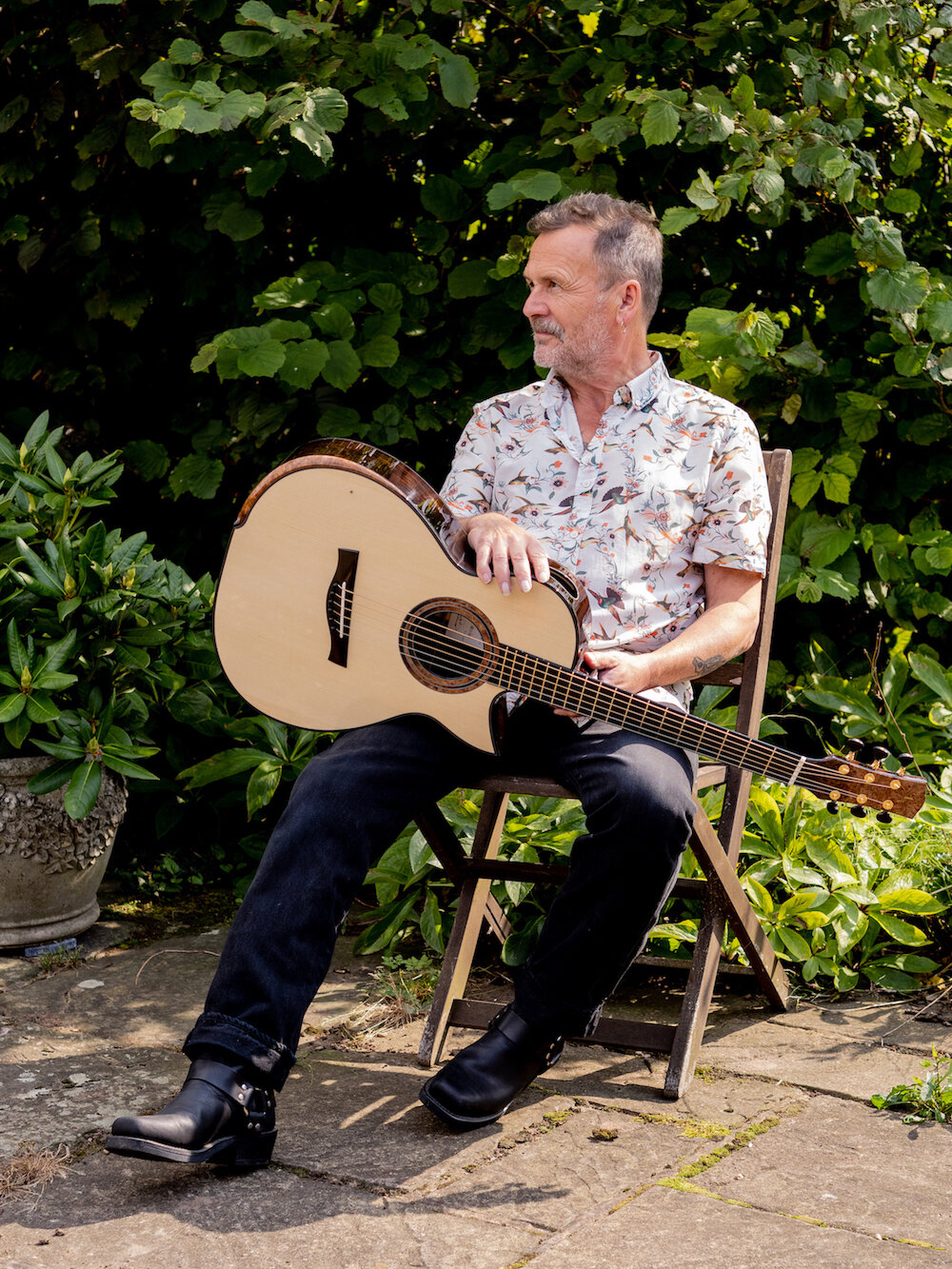
A fine specimen
Well, I'm afraid I'm no more enthusiastic about folk music afterwards, but it says something that when the gig ended, I was impressed to find that almost two-and-a-half hours had passed. Martin Simpson is an amazing guitarist and a seasoned pro who can easily keep an audience entertained with stories between songs, and the time only started dragging right at the end. Simpson's playing on his gorgeous Taran Tirga Mhor fan-fret acoustic was stellar, and the sound in the church was wonderful: clear and balanced and just the right volume.

I was surprised that there weren't any instrumentals, as I think it would have varied the pacing and dynamics of the set (and my companions at the gig confirmed that he usually features two or three). I wasn't surprised at the political opinions: Simpson is predictably left wing and got a few predictable cheers from predictable comments. I'm broadly sympathetic to such positions but I feel that these sound-bites cheapen the discussion and are out of place - yes, even at a gig like this, which might contain protest songs. Thankfully there wasn't much of it.

Overall, I'm pleased I got to see such a distinguished guitarist in the flesh, as I'm unlikely to do so again and certainly not so conveniently!

02/11/2021

Beethoven: Piano Music Volume 1

Alfred Brendel (piano)

Turnabout – TV 34251DS (year unknown)

It's been a very lengthy break in my increasingly inaccurately named Vinyl Album "of the Week" project. This was because my record player was misbehaving and so eventually I took it back to Richer Sounds in Southampton, who couldn't have been more accommodating or helpful. We listened to it in the store and they claimed to be able to hear some sort of distortion in the left hand channel as well. If I am honest, it was barely audible in that environment, which makes me think it's probably something in my home setup, sadly. They still sent it off to the manufacturer for checking and eventually got it back to me with a clean bill of health. Or, to put it another way, with no changes, since they couldn't find anything wrong.

Anyway, I got it back about a month ago and picked this album out, at random, for the next in the series. Unfortunately, it probably wasn't a great choice. Each of the several pieces on this album is a variation on a different theme by another composer. They feel a bit like academic studies, exercises for students or just a demonstration of the different ways a single theme can be changed, reharmonized or turned upside-down. I'm sure it's very sophisticated - this is Beethoven, after all - but it all goes completely over my head. As pieces of music, they seem meandering and aimless. The only bits I can remember are some particularly dissonant chords during the "Eroica Variations" (aka "15 Variations & Fugue On A Theme From ''Prometheus'' In E Flat Major, Op. 35" - catchy title!) that caught my ear because they stick out so much.

02/10/2021

First Impressions 4: The View From Halfway Down

 Andy Bell (2020)

[First impressions of albums bought in my September 2021 spree]

With a title that reminds me of Kermit's nephew, I wasn't sure what to expect from this. Andy Bell has had a varied career, starting in teenage shoegaze sensations Ride, via underrated Britpop also-rans Hurricane #1 and then to a surprisingly long stint with obscure pub rockers Oasis. His stint in Hurricane #1 in particular showed what an inventive musician he is - just have a listen to "Remote Control" or the single of "Rising Sign" (the album version is the annoying MBV remix, for some reason).

What we get is has obvious similarities with Ride, but a bit less intense, instead being more relaxed and laid back. The whole thing has a late sixties/early seventies feel, with the most obvious influence being Neu, whose "Hallogallo" groove crops up a few times, mixed with the psychedelia of early Floyd and Traffic.

Stand out tracks for me are the first track, "Love Comes In Waves", which has very Ride-esque harmonies over a motorik groove and reverb-drenched guitars, and the last track, "Heat Haze on Weyland Road", which caught my ear with its Kraftwerk-ian retro electronica. In between these two are some nice sounds, like the great backwards guitar work on "Aubrey Drylands Gladwell" and the acoustic Neu-ness of "Skywalker". There's a few too many instrumentals and occasional nothingy noodliness that I could do without, but overall it's a good album that doesn't outstay its welcome at eight tracks - an album I'm pleased to have found entirely by accident and will be listening to again.

27/09/2021

First Impressions 3: Tin Machine II

Tin Machine (1991)

[First impressions of albums bought in my September 2021 spree]

This was not the US cover
I've always had a bit of soft spot for Tin Machine, ever since I saw their live promo film in the cinema as a supporting feature to some film and really liked it (although the girl I was with was deeply unimpressed). At the time, it was a very deliberate break with Bowie's tradition and of course I bought that first album straight away. So I suppose it tells you everything you need to know about the extent of my alleged soft spot that I didn't buy Tin Machine II until (ahem) thirty years later. Was it worth the wait?

Well, I'd hate to leave my single reader in suspense, so let me say straight away: no. It's never going to be one of my favourite albums; it's not even one going to be one of my favourite albums of 1991.

Still, it's not a total loss. It's got the same feeling as too many of Bowie's later albums, of trying a bit too hard to get something new, pulling seemingly disparate elements together without quite making them gel, and forgetting the tunes, but there's plenty of interesting moments. I could do with fewer of Reeves Gabrels' "far out" (i.e. tuneless) solos, but the rhythm section is rock solid and it's all very cleanly produced. I do find the juxtaposition of straight-ahead rock and Bowie's unique, very mannered phrasing a little jarring, but it's interesting to note that when Hunt Sales sings (e.g. on "Stateside"), it fits the style of music better but instantly becomes more generic

Any standout tracks on first listen? "Amlapura" strikes me the most, more for being a decent Bowie track instead of a Bowie-playing-at-rock track. "Sorry" works well as an overall performance, with the various parts coming together well. I'm sure other tracks will emerge when (if?) I listen to the album more, as there's plenty of interesting moments. Absolutely non-essential but nice to have all the same.

23/05/2021

The Best of Nat King Cole

 Nat King Cole

Capitol Records - ST 21139 (c1968)

The next random selection managed to pick out one of the few "pop" records in my grandparent's collection. This was obviously a popular choice in their househould, as it showed signs of being played a fair amount - the cover is well used and the record itself, while in good condition, wasn't particularly clean (I'm fairly certain there were some bits of chocolate on it).

It's nice to have short, easily digestible songs, and while some are very much of their time ("Those Lazy Hazy Crazy Days of Summer" has some particularly cringe-inducing lyrics to modern ears), they all sound pleasant. I was familiar with about half of the songs on this album - the timeless classics such as "Unforgettable" of course - but it's been nice to hear others. Tracks like "I Don't Want to be Hurt Anymore" or "Dear Lonely Hearts" sound almost country; "L-O-V-E" is as swinging as anything Sinatra has recorded (it's interesting to note that both singers worked with the same arrangers, such as Nelson Riddle).

I have a particular fondness for "Let There Be Love", as I think my parents had this on 45 and I must have been hearing it since my teens. Cole's voice is remarkably consistent across all these songs - perhaps he doesn't have the range of a Frank Sinatra, but his vocal quality is of course unique and instantly identifiable. Easy listening in the very best sense.

[side note: I'm cheating a bit again, as my record player is still playing up, so I mostly listened to this on Spotify. I'm a bit disappointed - I really wanted to be playing the actual discs - but I wanted to carry on with the listening anyway]

17/05/2021

Bruckner: Symphony No. 8

 Chicago Symphony Orchestra

Conducted by Daniel Barenboim

Deutsche Grammophon - 2741007 (1981)

My Vinyl Album of the "Week" project has looked like being decreasingly well-named of late, and partly this is because I was determined not to just skip this record, even though I have found it really hard to like. It's too long for me to be able to get a grip on, with each movement more than ten minutes long and some over twenty. Perhaps what I needed to do was listen to each movement individually rather than attempt the whole symphony each time.

I can pick out some repeated themes, but as a whole it seems to jump from this to that, without seeming to have any connection between what I shall, in my ignorance, refer to as "bits". As you'd expect, the orchestration is never less than excellent and there's undoubtedly harmonic sophistication going way over my head - but, as a whole, I found it in part too daunting and in part just too much. I couldn't concentrate for long enough to get an overall picture in my head. Clearly this is my failing - apparently this is one of the greatest symphonies of all time - but I can't say it's a piece I'll be rushing back to.

On the last side (of four) is Bruckner's Te Deum, a piece which is amuses me (entirely unoriginally, I'm sure) to think of as "tedium", although I haven't listened to it more than about twice. It has operatic singing on it which was never going to interest me anyway, and now it's time to move on to another record.

The other reason this took me so long to write up is because this record seems to either illustrate shortcomings of my record player, my setup, or possibly both, as the louder sections distort noticeable in the left hand channel, which is very distracting. It might be the record, although, remarkably, this was still sealed in its cellophane until I played it, so it can't be previous damage. I think it's mostly sorted out now - I've readjusted the tone arm multiple times - but it just reminds me how fragile and fiddly record players are. Other than the sentimental value of listening to it - which is valid - there are no other reasons I can think of to bother.

30/01/2021

Schubert: String Quartet No. 14 in D minor (Death and the Maiden)

Amadeus Quartet

Deutsche Grammophon - 138 048 SLPM (1969)

Unlike the last VAW, which I felt was nice but uninvolving, this piece has a very definite sense of mood across all four movements, and in particular the second, Andante Con Moto, which is just fantastically mournful. As the title it's often given indicates, there's a sense of approaching death and doom, which is apparently because Schubert himself was not well around this time. That said, despite this background and the informal title, most of the piece is quite fast, but with a sort of desperate energy. Only the second movement is slow, starting with a kind of death march and moving to a powerful, stately melody. Great stuff.

When I first listened to this, I was slightly inclined to wonder if the slight tinny-ness of the sound was due to my record player or the recording - which originally dates from 1960, according to discogs.com. However, in part, I think it's because the string quartet format itself tends towards this: with two violins and a viola, there's a lot of high frequencies, with only the cello rounding out the sound at all. However, when I listened a bit more, I was grabbed by the melodies and the subtlety of the arrangement became a bit more apparent. Because there are only four parts to listen to, it's easier to appreciate how they work around each other (I mean, who can listen to all parts in an orchestra? Maybe a few people, but not me); I still prefer the sound of a full orchestra, but this manages a fair bit of drama and dynamics itself.

Filling up the space at the end of the record is a single movement from an uncompleted string quartet in C minor, which is fairly unmemorable. The recording itself is, as far as I can tell, not available on Spotify, although several other, probably later, recordings by the Amadeus quartet are, and well worth listening to. My copy is somewhat scratched (it's the same age as me, so you know, fair enough) and I still don't find that charming.


11/01/2021

Haydn: Symphonies No. 99 & 100 (Military)

London Philharmonic Orchestra

Conducted by Eugen Jochum

Deutsche Grammophon - 2530 459 (1974)

My Album of the "Week" has fallen behind a little recently, what with holidays and so on - but mainly because I couldn't really get a handle on these symphonies. Which is odd, because they are choc-full of nice orchestration and pretty melodies, most of which I can now hum along with (although I couldn't, out of context). I realised that I was trying to find some overall theme or meaning for the pieces, which is unreasonable, since I wouldn't necessarily expect the same from a pop or rock album.

Considered then as a collection of bits of music - albeit complex, intertwined and linked - it's been easier for me to get my head around. There are many different moods evoked, the transitions are superbly done and it's never less than very listenable. However, I'd be hard-pressed to pick out any stand-out moments. I think I prefer Symphony 100 slightly over 99, but sadly it all fades into the background a bit unless I am really concentrating. All of which sounds like damning with faint praise, I know, but I do actually like these pieces. Probably I am still unable to fully appreciate this kind of music.

Disappointingly, I haven't been able to listen to the vinyl of this, since it is very dirty and distorting unpleasantly (hopefully it's the record and not my needle ...). However, I found what appears to be the exact recordings on Spotify, so that's what I've been playing.

22/11/2020

Beethoven: Piano Concerto No. 3 In C Minor (Op. 37)

 Scottish National Orchestra and John Lill (piano)

Conducted by Alexander Gibson

Classics For Pleasure - CFP 40259 (1977)

I was initially at a bit of a loss for what say about this. It sounds like quintessential "classical music" to my uneducated ear: lots of orchestral play, pianist whizzing up and down the keyboard. I think partly this is because I don't really understand the concerto form, but partly because there is just a lot of music here, a lot of thematic development, which if I am not listening carefully tends to all sort of merge together, leaving a generic "sound of orchestra playing some classical music" impression on me.

Obviously this is just my ignorance, since firstly, this is Beethoven and therefore clearly not just "generic"; and secondly, if I do listen carefully, I do actually hear repeated ideas. It's just that I'm not used to listening for them in this way - and maybe a little that I don't find them distinctive enough to notice them the second or third time round.

Anyway, the opening theme (or "riff" as I kind of think of it) is stated quite clearly by the orchestra right at the beginning, and we keep hearing it throughout the long first movement. In fact the first movement has several sections by itself (mini-movements?), and the piano and orchestra keep coming back to that opening riff theme, apart from during a fairly long cadenza (which is basically classical music speak for "solo", it turns out), which I personally could do without, since the sound of the piano by itself is a bit underwhelming.

And that's true in general: the best parts are where the orchestra and the piano are playing off each other, echoing what is played or supporting. I prefer the first and third movements (cadenzas notwithstanding), because they have the biggest and most dramatic passages. The second movement is a lot slower and quieter and less interesting.

As an aside, this is probably the dustiest record I've listened to so far, which means it was probably played quite a bit - which is nice to know. (And when I say dusty, I don't mean it was covered, or indeed obviously dirty at all, but the needle picked up quite a bit every time I played this, which needed cleaning off otherwise the sound started getting all distorted).

15/11/2020

Stravinksy: Petrouchka / The Firebird

Chicago Symphony Orchestra

Conducted by Carlo Maria Giulini

His Master's Voice - ASD 2614 (1970)

Stravinsky's The Rites Of Spring is one of the few classical pieces I've known and been a fan of since my teens, but I'd never listened at any length to any other of his works.

These two pieces were originally conceived as ballet scores. While I can tell that they would provide suitably dramatic counterpoint to a story being told in a ballet, without the dancing in front of me, the music itself feels like it jumps from mood to mood with no reason. I've never seen the ballets (it's a form of artistic expression that leaves me bewildered and nonplussed) but I can kind of imagine a narrative that goes with each piece. The notes on the back of the sleeve give a quick summary of the stories, which helps a bit.

The music itself is fantastically scored and very effective at invoking moods, but so far I have failed to detect any recurring themes to hang on to. And without these, or the dancing, the music runs the risk of sounding like an empty exercise in instrumentation. Just like ballet seems to me to be an empty exercise in making dance shapes, I'm afraid.

This record took me two weeks, partly because I struggled to get into the music and partly because my record player was out of action for four days while I redecorated my study.


01/11/2020

Cherubini: Requiem in D Minor

New Philharmonia Orchestra with The Ambrosian Singers (directed by John McCarthy)

Conducted by Riccardo Muti

His Master's Voice - ASD 3073, 1975

I'm really enjoying how varied this collection of music I've inherited is. Luigi Cherubini (great name) was Italian and much admired by Beethoven, among others, but isn't a composer I have ever heard of - although in fairness, perhaps this isn't saying much; I hadn't heard of three of the four composers on last week's record either. This piece is a requiem and according to the blurb on the back cover, written to be performed at the composer's own funeral and in response to an earlier composition of his being banned in church on account of featuring (gasp!) female voices; as a result, this has only male voices.

The sound of a chorus of people singing is a uniquely affecting sound, whether they are singing softly or loudly. The fact of the religious setting is largely immaterial, since I have no idea what they're singing, and all I know is it makes for some very dramatic music. I suppose that this is a piece of music for a funeral makes sense; it does, by and large, sound very sombre, particularly at the beginning and end, which makes for a nice sense of closure.

What it doesn't make for is a particularly relaxing listen though - some of the sudden bursts of sound from the orchestra and chorus combined have made me jump. I can't help but feel that this would have made for a very long funeral service - but as a piece of (effectively secular) music, it's very impressive. In some ways, a week isn't enough to get to grips with all of it, sadly.

25/10/2020

Russian Rarities: Glière, Stravinsky, Cui, Gretchaninov

The London Symphony Orchestra and Osian Ellis (harp), Joan Sutherland (soprano)

Conducted by Richard Bonynge

Decca - SXL 6406, year unknown, probably late 1960s

The first side of this record is Reinhold Glière's Concerto For Harp And Orchestra (Op.74). The combination of harp and orchestra is an unusual one (in my huge experience) and it only partially works. The harp is a beautiful-sounding instrument but it has a limited range of expression: it can't sound urgent, powerful or in fact much else other calm and tranquil, even when it's being played urgently (or indeed powerfully). That means the slower, second movement here (Tema Con Variazioni (Andante)) is more successful than the first and third, in which the harp is sometimes in danger of being over-powered by the orchestra. The music is pleasant enough but hasn't lodged in my memory.

The second side is more memorable, but generally not for the right reasons. The four pieces all include Joan Sutherland singing, in the first two without words. This has given me the opportunity to learn that coloratura is not my cup of tea.

In particular, Glière's Concerto For Coloratura And Orchestra (Op.82) is hard work, despite including some pretty melodies and some very clever interplay between the voice and orchestra in the second movement, because the style of voice is one I find so off-putting. I wasn't sure if this was just Joan Sutherland's particular style (I'm told that singing styles have changed between the then and now) so I listened to some more recent recordings of the piece and while they are not quite as frilly, it's still not something I'd choose to listen to. This isn't to take anything away from Sutherland, who sounds amazing.

Stravinsky's Pastorale (Song Without Words For Voice And Four Wind Instruments) is more interesting (and shorter), and the final two pieces (César Cui's Ici Bas and Alexander Gretchaninov Lullaby) are the classical album equivalent of album filler.

18/10/2020

Mendelssohn: Violin Concerto (Op. 64)
Bruch: Violin Concerto No. 1 (Op. 26)

The London Symphony Orchestra and Ruggiero Ricci (violin)

Conducted by Pierino Gamba

Decca ‎– LXT 5334, 1958

Despite playing the guitar I have little interest in very "technical" guitar music that feels like a demonstration of technique over taste, and initally these two violin concertos seemed it belong in a similar category. Every possible way of playing the violin seems to be used, possibly just because it can be.

But they've grown on me, not least because they both have actual tunes. I'm probably being very gauche by calling them tunes when they're more properly called "themes" or something, but if you can sing along with it, it's a tune as far as I'm concerned!

Wikipedia says that Mendelssohn's violin concerto is one of the most popular violin pieces in history, as well as one of the most technically demanding. I can see why it's so popular, as it's very dramatic and I'm sure that in performance, the soloist can make the most of all the opportunities to show off. Sometimes it seems like it's a little unnecessary, but there's a lot in there and I think I'd need more listens.

The same can all be said of Bruch's violin concerto also, which feels like, at heart, a very similar piece of music, certainly structurally. Maybe all violin concertos are similar in that sense though, although reading up about it, apparently Bruch was heavily influenced by the earlier work.

I've enjoyed both pieces and - thanks to those tunes - I might even recognise them out of context if I was to hear them again. However, these particular recordings do illustrate the downside of having old vinyl; despite being in amazing condition for a record that is over sixty years old, the recording and transcribing technology of the time (particularly in mono) leave this sounding a bit like film music from old black and white films. This is probably not helped by the (melo)dramatic nature of the first movement of the Mendelssohn concerto in particular. So even though this is on Wikipedia's list as a notable/award-winning recording, I'd want to hear a more recent version.

EDIT: having now heard a couple of more newer recordings, this stands up surprisingly well. Ricci's playing is, I think, more vibrato-laden than modern technique would call for, but actually I quite like this and it suits the music.

11/10/2020

Mozart: Trio In E Flat Major (K.498); Quintet In A Major (K.581)

Gervase de Peyer with members of the Melos Ensemble

His Master's Voice ‎– ASD 605, 1964

At first I found both of these pieces rather light and possibly even a bit twee, by comparison with the full orchestra compositions I'd been listening to so far for VAW. But they've grown on me - I've even come to prefer the trio (side A) over the quintet (side B).

The trio is known as the Kegelstatt Trio and my guess (even before I read the Wikipedia article) was that the unusual combination of instruments - clarinet, viola and piano - might indicate that it was composed for a specific combination of people, or maybe even as an exercise for a student. Apparently both of these guesses are true, probably (good for me!). It's a pretty, light piece, with enough melody and movement to entertain and keep interest up. After a few listens, I found myself humming along, so even though I don't think I could recognise it out of context, it's enjoyable.

The second side has the Stadler Quintet, composed for and first performed by clarinettist Anton Sadler, who was also part of the first performance of the Kegelstatt Trio - hence the combination of pieces on this record, I suppose. The orchestration is slightly fuller and so there's more going on, which is maybe why I remember it slightly less. But again, it's an attractive, undemanding piece.

I haven't been commenting on the quality of the performances in these blogs - I don't have the knowledge or experience to do so, and in any case, to be worth committing to vinyl requires a minimum standard. It sounds good to me, and a good recording too.

04/10/2020

Franz Schubert: Rosamunde

Netherlands Radio Chorus & Concertgebouw Orchestra Amsterdam

Conducted by Bernard Haitink

Philips ‎– 6570 053, 1965

Apparently this was composed as accompaniment for a now largely forgotten play concerning an heiress to the throne of Cyprus who is raised incognito as a shepherdess. It's impossible to assess whether the score matches the play, but there's plenty of drama in the music here - even just in the Overture, which ranges across grand orchestral stabs to bouncy tunes, all in about five minutes. The sleeve notes say that the most well-known pieces are both on the second side, those being "Entr'acte 3" and "Ballet Music No. 2" but neither of them ring any bells, so I don't think I've heard them before.

There's a bit of singing: the individual contralto (Aafje Heynis) is a bit too frilly for my taste, but the chorus sounds great - so far, both of the albums I've listened to have choruses on them and I like it; they sound so big and powerful. Overall, it feels like it wanders around a lot, thematically, without ever settling down to a direction. But it's nicely scored and played and is excellent Sunday morning music.

As an aside, I rather like the picture on the cover (Holman Hunt's The Hireling Shepherd), in which a wonderfully skeptical-looking young woman is being courted by (presumably) a shepherd. Given that the play is about a cypriot princess, the only relevance it has is that it involves sheep, but never mind!

27/09/2020

Joseph Haydn - Die Jahreszeiten

Chorus & Academy of St Martin-In-The-Fields

Conducted by Neville Mariner

Philips - 6769 068, 1981

This is my first Vinyl Album of the Week™ and I probably could have picked something easier to start with. What I know about classical music is whatever is in Bluff Your Way In Music, minus the bits I've forgotten. What I know about classical music that features singing is even less, because having been immersed in pop and rock for so long, I find operatic-style voices overly mannered and fake.

So this three disc set of Haydn's Die Jahreszeiten (The Seasons) - a secular oratorio (it says here) - was always going to be a bit of a slog for me. But actually, it hasn't been at all. For some reason - maybe the novelty of the music, or that of having a shiny new turntable to play with - I've really enjoyed putting this on most mornings. Something about the grand, sweeping orchestration and the rich, resonant voices seems to suit my breakfast and morning cup of tea very well. I don't know, maybe it subliminally reminds me of mornings with my Dad, who would usually have Radio 3 on over breakfast.

Figuring out what part is actually playing at any given moment is a little tricky, as there is no track listing apart from on the record labels themselves, which, inconveniently, are spinning round and round at the exact moment I want to know what I am listening to. There is a very nice, twenty page booklet the same size as the box (i.e. 12") which has all the words and (if you look carefully) a note about what side each "song" (?) is on. So actually, my reference has been Discogs.

So, I can tell you that I like the Overture at the very beginning: very grand and stirring; and the combined might of the orchestra and chorus at the end of Freudenlied ("Joy Song", part of "Summer", end of side 2) has a magnificent power to it. However, it's a lot of music to listen to and I'm still taking it in, so I couldn't name any more moments yet. No melodies stand out; perhaps this is a lack of familiarity with the genre as much as anything else (Haydn doesn't seem to go for verse/chorus structures much ...) and while much of the music is very well done, it seems perhaps a touch "generic classical". That said, it was first performed in 1801 so maybe it started here, I dunno.

Obviously I can't comment on the performance itself, except to say that it seems very good. Given that it's available on Spotify, it probably says something about it. The vinyl I have is spotless; I wonder how much it was even played?

22/09/2020

Vinyl Album of the Week Project

New project! I have decided to listen to one album a week from my collection of vinyl.

This is quite a large project, as I have a lot of records (I realise this is relative; it's "only" 4-500, which some people would no doubt consider pretty restrained). They're mostly classical and mostly inherited from my grandparents, from both sides of my family. It's all been sitting in boxes and then cupboards since I got them, which is now several years ago.

I have this collection because no-one else seemed to want all these records, and it seemed a shame to just ditch it all. My grandparents were keen listeners to music. My dad's parents went to the Proms every year and in later years were stewards at the Barbican, enabling them to hear music and be paid for it! They also had a decent collection of records and had been members of a music appreciation society, where they would go around to each other's houses and listen to albums. In this era of music on demand, that seems archaic, but it's easy to forget that one album cost the same as a month's Spotify subscription. I know less about what my mother's parents enjoyed but since they had a larger collection, it seems only reasonable to assume it was also something they counted as a hobby. So all these records were presumably valuable to them and were listened to.

Anyway, as a result, I have what might charitably be called an eclectic collection, ranging from the fifties to the mid-eighties, covering all sorts of classical music, but also a little easy listening, American-songbook type albums and the occasional pop record (I did notice an original 1967 copy of Sgt. Pepper in there - excellent condition but not worth much because, of course, it sold millions!). 

They all now sit comfortably in a custom-built cupboard (not built for me, it was in the study when we bought the house), nestling alongside the vinyl I bought as a teenager, before I moved to CDs in about 1988.

I've been thinking about doing this for a while, but it was made slightly more difficult by the lack of a record player. Actually I did have one for a while, another inheritance from a grandparent, but it didn't work very well. It was a Technics, so potentially a decent turntable, but I think this one was actually just part of a whole system so probably at the cheaper end of the market - in about 1985. Anyway, each time I tried to use it, the sound cut out, so eventually I gave up and got rid of it.

However, a couple of weeks ago, prompted by a reorganisation of the study and the consolidation of all the vinyl into one cupboard, I decided to finally buy a proper turntable - the first I have ever bought, in fact. I didn't want anything fancy but did want something of a similar sort of quality as the rest of my hi-fi system. (Actually, most of my system is "starter" grade by the standards of serious aficionados ... but oh well. It sounds pretty decent to me.) I eventually plumped for the Pro-Ject Debut Carbon DC, which gets good reviews and comes with an upgraded Ortofon 2M Red cartridge (bought from Richer Sounds, superb service from them, by the way).

I've had it for a couple of weeks now, and I've been enjoying spinning the occasional disc. It's such a different experience from how I normally play music now, and it's fun to be reminded that this is how I listened to music for much of my formative years. But it's such a faff! I'm definitely not one who finds the ceremony of carefully extracting the record from its sleeve, placing it on the platter, cleaning it, locating the needle precisely, and finally lowering it, enhances the experience in any way. It's just tedious.

Nor do I think the music sounds better for the all-analogue signal path. I've A/B'd couple of albums now and while I can hear differences, I think it's much more to do with the mastering that the playback technology.

For example, ABBA's Arrival definitely sounds more "open" on vinyl than CD (actually, ripped to FLAC, fwiw), but the audio on CD sounds to me like it's been compressed to make it louder - which was a very 90s thing. On the other hand, I compared a recording of Haydn's Die Jahreszeiten on vinyl and via Spotify, and the streamed audio was slightly more detailed, although not by much. Indeed, one of the surprises to me was generally how good the vinyl sounds. I don't quite know why I was surprised by this, but I was.

But I am still going to do this, despite it being a faff, and despite there being no real difference in sound quality, and even despite finding that quite a few of the recordings are available on Spotify. It's not really the point. These albums belonged to my grandparents. They are literally irreplaceable. It's a way of connecting to them, and discovering a whole genre of music that I'm not very familiar with at the same time.

I don't have any structured way of selecting albums, since I don't actually know what I've got yet! I'm slowly adding to my collection on Discogs, and I will select each week from those I've already added to it. I'm giving each recording a week, because I know from experience that I have to live with unfamiliar music for a while so that it can sink in - and this applies double or triple to a genre like classical, which I don't really know at all.

The albums

  1. Joseph Haydn: Die Jahreszeiten (The Seasons)
    • Chorus & Academy of St Martin-In-The-Fields, conducted by Neville Mariner (Philips, 1981)
  2. Franz Schubert: Rosamunde
    • Netherlands Radio Chorus, Concertgebouw Orchestra Amsterdam, conducted by Bernard Haitink (Philips, 1965)
  3. Wolfgang Amadeus Mozart: Trio In E Flat Major (K.498); Quintet In A Major (K.581)
    • Gervase de Peyer with members of the Melos Ensemble (His Master's Voice, 1964)
  4. Mendelssohn: Violin Concerto No. 1 (Op. 64); Bruch: Violin Concerto No. 1 (Op. 26)
    • Ruggiero Ricci With The London Symphony Orchestra, conducted by Pierino Gamba (Decca, 1958)
  5. Russian Rarities: Glière, Stravinsky, Cui, Gretchaninov
    • The London Symphony Orchestra and Osian Ellis (harp), Joan Sutherland (soprano), conducted by Richard Bonynge (Decca, year unknown)
  6. Cherubini: Requiem
    • New Philharmonia Orchestra with The Ambrosian Singers (directed by John McCarthy), conducted by Riccardo Muti (His Masters Voice, 1975)
  7. Stravinsky: Petrouchka / The Firebird
    • Chicago Symphony Orchestra, conducted by Carlo Maria Giulini (His Master's Voice, 1970)
  8. Beethoven: Piano Concerto No. 3 in C Minor (Op. 37)
    •  Scottish National Orchestra and John Lill (piano), conducted by Alexander Gibson (Classics For Pleasure, 1977)
  9. Haydn: Symphonies No. 99 & 100 (Military)
    • London Philharmonic Orchestra, conducted by Eugen Jochum (Deutsche Grammaphon, 1974)
  10. Schubert: String Quartet No. 14 in D minor (Death and the Maiden)
    • Amadeus Quartet (Deutsche Grammaphon, 1969)
  11. Bruckner: Symphony No. 8
    • Chicago Symphony Orchestra, conducted by Daniel Barenboim (Deutsche Grammophon, 1981)
  12. The Best of Nat King Cole (Capitol Records, c1968)
  13. Beethoven: Piano Music Volume 1
    • Alfred Brendel (piano) (Turnabout)

21/08/2020

Wham! George & Me

Andrew Ridgeley

2019

Cover image
Wham! were a part of my teens by default really; despite the fact that I was never that bothered about their music, it's an indelible part of my history. (And in fairness, it's grown on me and I can get quite into "The Edge Of Heaven".) The fact that they grew up not that far from me wasn't something I knew at the time, although it's quite fun to see the familiar landmarks in the early pages of this book.

I suppose they're now increasingly known as the band that George Michael was in before he became a global superstar, but he's gone and this is their story, by The Other One. Andrew Ridgeley sometimes gets an unfair amount of stick for being a passenger - and given his achievements since Wham!, you might even consider that epithet justified. But really, anyone who has the sense to walk away from celebrity strikes me as a much more balanced individual than someone who carries on, continually trying to prove something. He had about five years in the limelight and then more than thirty years of probably very comfortable living off the back of it. That's a deal I'd take.

It's still a bit of a puzzle what Ridgeley actually did in Wham! He was the driving force behind originally getting a band together, he says, and he had a hand in some of the early songs (apparently he still earns a handsome amount from the sales of Careless Whisper every year), but by his own admission, he handed the creative reins to Michael fairly soon into Wham!'s short life. But again, you could regard this as the action of a normal person. With what seems like a lot less ego to satisfy than most "stars", he says he could see how good George Michael was becoming, and was happy to take second place to him.

That said, Andrew Ridgeley obviously has enough of an ego to want to finally put his side of the story, and I was interested enough to read about it - in fact, I got through it in a couple of days. But although it's easy to read, the book is curiously un-engaging. It seems obvious to me that it's been ghost-written (even though there's no other credit), as the writing has a bland, practised, tabloid-esque glibness that obscures any sense of the real person, which is a shame.

What does come across is the story of an ordinary, normally talented teenager who was lucky enough to be best friends with the boy who became George Michael, and who got to live that life for a few years, and then went happily back to semi-obscurity. Good for him, I say.


27/09/2019

Dance Mania Vol. 1

Tito Puente & His Orchestra
1958

About eight years ago I pledged to brush up on my knowledge of the music of the 50s by listening to all of the "must listen" albums from a couple of big list books. I'm still working my way through them (hey, there are nearly forty albums!), and here's one of the last to write up.

I knew nothing about mambo - let alone the Tito Puente, the "King Of Mambo" - prior to listening to this, and in all honesty I think I'd struggle to distinguish between it and,say, merengue (the latter is more of a "marching" beat, apparently).

Dance Mania probably serves as a good introduction, even if it doesn't include the song most rock music fans would know Puente for, "Oye Como Va" (as covered by Santana on Abraxas). Unfortunately, not being familiar with the intricacies of the style means that all the tracks here tend towards sameness. It's all a bit early-60s jazz club, like the Purple Pit in Jerry Lewis's The Nutty Professor -  jazzy and brassy, maybe a bit like big band swing, except more relaxed. Great if it really floats your boat, maybe a bit wearing after twelve tracks of what is broadly indistinguishable music.

A couple of the instrumental tracks stand out for me: "Hong Kong Mambo" is a great riff, and "3D Mambo" has a great feel. Overall, it's good for something a bit different in the background though, and as ever with these recommendations, I'm very pleased to have heard it and know it.

16/11/2018

II (Föllakzoid)

Föllakzoid
2013

Since I already have a couple of Neu! albums, I'm not sure I need this. It's fairly generic trance-rock/krautrock of the kind that's huge fun to play - and fun to listen to under the right circumstances. There's not a lot of variation between tracks though, nor much variation or dynamics in the tracks themselves - although, to be fair, that's not the point of this kind of music.

Great cover though.