Showing posts with label mojo collection. Show all posts

24/06/2018

Newport 1958

Mahalia Jackson
1958

Like most people, probably, I think I'd claim to know gospel when I hear it, but I wouldn't have identified this as such. This is just Ms. Jackson singing by herself, with minimal - but effective- backing instrumentation, primarily from a piano and occasional organ. Where's the mass choirs and fevered chanting?

All of which shows how much I know. My entire knowledge of gospel is the five minutes it takes James Brown to sing "The Old Landmark" in The Blue Brothers, so it's fair to say that I am not the best informed about the subject. Listening more carefully, as well as the obviously church-based lyrics, the chord progressions are very typical of gospel - at least, I assume so, because it sounds like early soul. What is striking is how funky some of it is, and you can see the direct line from "I'm On My Way" to Ray Charles's "Hallelujah I Love Her So", and from there to the sixties' twin peaks of Motown and Stax.

Mahalia Jackson's voice is fantastic and the whole thing sounds great fun. She's also sweet when the audience is clapping and she says "You make me feel like I'm a star" - although surely she was, since otherwise why would she be at Newport Jazz Festival, for the second time?

Needless to say, this isn't something I would have chosen to listen to or even known about had it not been in a list in a book, so I'm grateful to have been exposed to it. I'd even probably listen to it again some time.

20/11/2017

Abbey Road

The Beatles
1969

I came to Abbey Road relatively late - which is to say, for some reason I was at least ten before I listened to it properly. Given that at seven I was putting A Hard Day's NightRubber Soul and Sergeant Pepper on constant repeat, it's an odd oversight.

Perhaps this late-coming is why it's never been such a favourite as other Beatles albums. It hadn't embedded itself into my juvenile subconscious in the same way. Or maybe it's because ... well ... it's not really quite as good?

For a classic album, let alone a Beatles album, it really does have a lot of filler. Fully half of the first side is bordering on awful. I know they had to let Ringo sing on a track but really, "Octopus's Garden" is just rubbish. "Maxwell's Silver Hammer" is trite and unpleasant. "Oh Darling" just sounds like Paul's trying too hard. It's even more puzzling when you consider that the remainder of those six songs are fantastic, in particular the ground-breaking "I Want You", real heavy music to a ten-year-old.

Then there's the second side. After "Here Comes The Sun" (about as good as a song can actually ever be) and "Because" (disposable) comes the much-vaunted medley. A medley of songs that weren't quite finished or good enough to make it as whole pieces. It actually only starts to make sense with "Golden Slumbers", more than half way through. Then, I'll grant you, it's superb. The duelling guitars on "The End" are just fantastic - and then we get that perfect ending couplet: "And, in the end, the love you take / Is equal to the love you make". (Which they then spoil by having a joke song follow it.)

Still, I suppose the fourth or fifth best Beatles album is still good, eh?

19/11/2017

C'est Chic / Risqué

Chic
1978 / 1979

If all you know of Chic is "Le Freak" and "Good Times" then you might assume that they were a pure disco party band. However, as Nile Rodgers - a man who seems to be everywhere these days - has stated, their ambition was to present a whole, sophisticated image (hence the name). So in fact, despite the globe-straddling dominance of their most famous tracks, they don't really represent what Chic were really about.

More representative of both albums' feel are the lesser-known singles such as "I Want Your Love" or "My Forbidden Lover": groove-laden but laid back and infused with an undercurrent of mournfulness. Album tracks like "Sometimes You Win" or "Can't Stand To Love You" are much more in this vein, while full-on ballads like "At Last I Am Free" and "A Warm Summer Night" fit the relaxed mood much better.

Overall, then, the feel of both albums is surprisingly a lot less immediate than I expected, given the band's reputation. Indeed, my initial impression was one of slight disappointment. But a number of repeated listens have brought out the appeal in tracks like "What About Me" - a nice groove - or "Savoir Faire" - a smooth instrumental with some very tasteful guitar soloing.

Talking of guitar, as the last surviving male member of Chic, Mr Rodgers has become the face of the band, and there's no doubt he's a superb and unique guitarist. However, the real engine behind the music is unquestionably Bernard Edwards, whose wonderful, funky bass winds, bubbles, growls and powers through the grooves, forming the backbone around which everything else hangs.

Released in consecutive years, during which Rodgers and Edwards seemed to be doing a million other projects too, these two albums are not identical in feel but do form a very consistent whole. And while they are not disco party albums, they are satisfying listening.

15/09/2016

Fresh Fruit For Rotting Vegetables

Dead Kennedys
1980

I've known Dead Kennedys tracks like "Kill The Poor" and "California Über Alles" for a long time but never listened to the whole album. But there it is on my "Eighties in Music" list, so now's a good a time as any. It's not available on Spotify so I've had to resort to the lawless wild west of YouTube to hear it.

First impressions: it's full of energy and Jello Biafra's voice is cool in a whiny kind of way, while the music is surprisingly varied. It's obviously a low budget production but that's appropriate for the style. Best of all, it's nice and short. Not in the "thank god that's over" way, just about a dozen short tracks.

Some of the lyrical targets are very dated, some are obscure, but most tracks are musically interesting enough to make listening worthwhile. The singles are good - not least because there's the semblance of a tune: I particularly like "Holiday In Cambodia" because it has a great intro, moody verse and some great playing (although lyrically it's hardly cheery); and "Viva Las Vegas" is great, probably because it's best tune on the album and I know it best. It suits their style, funnily enough, although I'm sure it's all heavily ironic given their known politics.

Not something you'd put on for repeated listens but it's enjoyable because of the energy and it has a place in history, of course.

13/09/2016

Back In Black

AC/DC
1980

Single entendres and loud guitars. What's not to like?

Some albums take a while to bed in, to seep into your consciousness or unconscious. On the other hand, some albums are pretty instant. I don't think I'd ever listened to Back In Black before today, but already I like it.

It wouldn't be fair to call Back In Black shallow, but there's not really a lot of depth or complexity here, nor is it needed. Titles like "Shoot To Thrill", "Let Me Put My Love Into You" (sample lyric: "let me cut your cake with my knife") aren't exactly difficult to decode, and the music is just as straightforward. But that doesn't imply that it's without power, excitement or dynamics. Obviously it's great rock - you don't sell million and millions on the back of sub-standard music.

I'm not particularly keen on the high-register screech-sing of much of this kind of stuff but Brian Johnson's voice has enough grit and personality to make up for it. The guitars are superb, of course, thick, crunchy and powerful. Even better, it's ten good tracks and doesn't outstay it's welcome. Classic for a reason.

28/02/2016

Lady In Satin

Billie Holiday
1958

I'm finding this a hard album to love. It's an album of standards, in the same vein as the contemporary Sinatra and Fitzgerald albums. But while those two singers were at the top of their abilities at the time, it's clear that Billie Holiday was at the end of her career, and it's uncomfortable listening to her voice. She sounds tired, and there's an underlying feeling that she might only be doing this because she has to (although from what I have read, this is not the case; she wanted to make this album this way).

Bill Holiday's phrasing is as distinctive as ever, although I can't help wishing sometimes that she'd clear her throat first, and the arrangements and musicianship are first rate. There's not much variation across the tracks and because her voice is so unusual, it also serves to blend the songs together somewhat. The overall result is to make the album a less enjoyable experience for me.

08/11/2014

Come Fly With Me

Frank Sinatra
1958

An excellently themed collection of travel-related songs, all given the trademark Sinatra treatment. The uptempo numbers swing nicely, particularly the specially commissioned title number, "Let's Get Away From It All" and "Brazil" (and also the extra-on-CD "I Love Paris"). Sinatra sounds more relaxed on these, whereas the lush ballads lilke "Around The World" or "Autumn In New York" are a little heavy on on the big strings and sound forced, although "London By Night" is lovely.

Oddly this is the opposite of what I found a year and a half ago, when I found the slower songs on In The Wee Small Hours more convincing that the faster songs on Songs For Swinging Lovers. Maybe this is to do with the arrangements, all by Billy May, whereas the other two were arranged by Nelson Riddle.

Still, it has to be said that this is Frank's golden period and none of the tracks dip below good, and Come Fly With Me is consistent with his other albums of the fifties in being superbly listenable. (It's also consistent with them in having terrible cover art.)

22/11/2013

The Circle Game

Tom Rush
1968

The Circle Game is somehow both endearingly of its time and yet surprisingly timeless. Helping the latter attribute is the presence of several classic songs; Joni Mitchell's "Tin Angel" and "The Circle Game", and "No Regrets", better known in The Walker Brothers' version.

But these tracks are - and this point is of course of prime importance to rock snobs and pop anoraks alike (I leave it to you to decide where I fit) - the originals. In 1968, Joni was an unknown and struggling songwriter, and Rush was trying to promote her. As a result his version predate hers. The contrast is interesting: "Tin Angel" here is a measured, autumnal reading. Joni's own version (from 1969's Clouds) is a brittle, slightly callow version, shrill by comparison.

Nor was Tom Rush any slouch himself as a song writer. Two of the best songs here, "Rockport Sunday" and the now standard "No Regrets", are his own. Again, the difference between the gently acoustic and melancholic original here, and The Walker Brothers lushly orchestrated 1976 cover is primarily one of subtlety. Tom Rush has a nicely understated touch on all of the songs here, even the more upbeat (and slightly less memorable) songs here.

An enjoyable find (thank you, The Mojo Collection) that hadn't registered with me ever before. Worth finding.

25/09/2013

The Kinks Are The Village Green Preservation Society

The Kinks
1968

For rock music, I think the key decade since the birth of rock'n'roll is the seventies. The developments in style and recording techniques during that time mean that while anything prior to it sounds irrevocably dated, anything post about 1977 (stylistic considerations aside) sounds almost, if not actually, modern.

As a case in point, here's The Village Green Preservation Society; all tinkly, faintly awkward English sub-psychedelia, it could not have come from any other time than the late sixties. It was even released in mono, for goodness sake! A mere nine years later and you can choose from the air-brushed, silken sheen of, say, Rumours or Aja, either of which sound like they could have been released last year, or the professional punch of Never Mind The Bollocks or News Of The World, guitar rock that has been constantly referenced since.

Anyway, this is an album of its time, then, and very reminiscent of others of its era. "Do You Remember Walter" sounds like the more whimsical bits of early Floyd. "Big Sky", probably my favourite track, could have come off Ogden's Nut Gone Flake or Jack Bruce's Songs For A Tailor. As  you'd expect from Ray Davies, decent tunes are in good supply, although a few sound somewhat contrived. The Village Green Preservation Society is a concept album, clearly (anything titled "<band name> are <something else>" can't be anything but) but I'm struggling to detect the concept. Musically, it sounds like a collection of pop songs - nothing more, nothing less.

As you might gather, I haven't been blown away. Nice enough, very evocative of a certain period, but I'd rather listen to Piper At The Gates Of Dawn.

08/05/2013

American Beauty

Grateful Dead
1970

So, what do I know about Grateful Dead? Not much. They were going for ages (still are, in some incarnations); they played extended, heavily improvised rock; they were best live; and they were one of the world's biggest cult bands ("a Deadhead sticker on a Cadillac"). So far, so hoopy, and therefore, armed with my minimal knowledge, I wasn't expecting this: a hokey, countrified, ballad-heavy album, with gentle, mostly acoustic instrumentation and camp-fire harmonies.

My first impressions of this album were that it was a poor copy of Crosby, Stills & Nash's first album (from 1968); the harmonies aren't quite as precise, the playing a little more sloppy. This is thrown into even more sharp contrast by side-by-side listens with CSNY's far superior 1970 album Déjà Vu. It's just not as accomplished.

Perhaps that's an unfair comparison. Déjà Vu is a timeless classic, whereas American Beauty sits very much in the late-sixties, combining a "hello clouds, hello sky" kind of hippy-ness with a bluegrass feel that I guess was becoming very current, what with the Byrds and Gram Parsons. This could be a bit wearing but thankfully it has plenty of pleasant tunes, and after a few plays they've started becoming memorable. Opener "Box Of Rain" has a slow, plaintive melody and keening guitar that reminds me a little of that in Richard & Linda Thompson's wonderful "When I Get To The Border". "Operator" reminds me of a Monkees song, unexpectedly, although I can't place which one right now. "Sugar Magnolia sounds a bit like Little Feat.

All of these things I'm reminded of are, for me, better than this. I'm a bit lukewarm about American Beauty. Another album whose place in the list of "greatest" is not justified, in my opinion.

28/01/2013

Back Country Suite

Mose Allison
1957

Polite, white jazz-blues that enjoyed a surprising following amongst sixties rockers, The Who going so far as to include a cover of "Blues" (as "Young Man Blues") on Live At Leeds. Why this should be so is less than clear to me. The music is uninspiring and pedestrian and Mose Allison's voice is, well, polite and white; fey, body-less and bordering on anodyne.

"In Salah", singled out in reviews I've read for particular attention, sounds to me like a dead ringer for "A Night In Tunisia". The album as a whole is very much of its time; pleasant enough in the background and is nicely short at a touch over half an hour.

Once again, as I have found with albums of a similar age by Fats Domino and Elvis Presley, what this album represents is historical value; it was ground-breaking; it now is run-of-the-mill. If it took a white man to impart a "respectability" that was perceived to be lacking in the music performed by black musicians for a decade or two, then great. But on its own merits, in the 21st century, it's distinctly unimpressive.

19/01/2013

Love Is The Thing

Nat King Cole
1957

Listening to this album today, and in particular having just listened to Frank Sinatra's emotional switchback duo of In The Wee Small Hours and Songs For Swingin' Lovers!, it's easy to assume Love Is The Thing was Nat King Cole's attempt at a similar concept. The big, sweeping string arrangements and the classic songs are all present and correct. Probably, though, this is just the kind of album that many singers were releasing, except we don't get to hear the also-rans sixty years later.

So why has this one endured? (And endure it has - it went platinum 35 years after its release). It's tempting to ascribe some of the album's longevity to its most famous track. "When I Fall In Love" is, of course, a timeless classic, but anyone who wants that can choose from a million compilations. People buying this album are looking for something more, albeit maybe more of the same, and that's what they'll get. There are other well-known songs, such as "Love Letters", and "It's All In The Game" in the same style. The whole album is a long soak in a lovely warm bath - listening to Cole's silky smooth voice is like luxuriating in a million bubbles - and the tempo never raises your pulse.

In some respects this is an easier listen than the Sinatra albums (C prefers it), but I think it is ultimately less rewarding. I do like it and Cole never lapse into cliché or sounds forced. But the arrangements tend towards the overly-sweet and the whole borders on inoffensive and is ideal background music.

18/01/2013

Songs For Swingin' Lovers!

Frank Sinatra
1956

Right here is where Sinatra cements his reputation and formulates his signature clichés, both of which would sustain him for the rest of his life. "You Make Me Feel So Young", which starts the album with a blast of brass, swings so irresistibly that your fingers start clicking automatically, while Frank booms his through words like "moon" and "balloon". And here's possibly the definitive performance of "I've Got You Under My Skin"; starting with quietly honking sax and building in shrillness and intensity to a fever pitch before fading back down right at the end. The classic Sinatra arrangement.

Listening to this straight after In The Wee Small Hours, it sounds very much like an attempt to reproduce the concept of the earlier album - except that instead of losers in love, this is for winners. As a result, it is a much brasher, less subtle affair. It is also a less consistently-themed whole, but the famous songs - including those mentioned above, along with "It Happened In Monterey", and "Makin' Whoopie" (an entire song about sex! In the fifties!) - are so well-known that this is probably the more famous album. I think that's a shame.

Not that this isn't also excellent, but repetition of the same clichés spoils it a touch. The way that Sinatra slides up to notes is uniquely his, of course, but he does it so much - and clearly deliberately, because it's not hard to hear that he can hit a note dead on when he wants - and with such foghorn-like tonality, that it does start to wear thin. He sounds strained when going for the big notes and the joviality can sound forced. I think he's much better at quiet songs.

07/01/2013

Four Freshmen And Five Trombones

Four Freshmen
1956

A kind of barbershop quartet close harmony that actually reminds me of nothing so much as Ted's band in Scrubs. Excellent of its type, and famous for being an influence on The Beach Boys, but I find the constant harmonised singing to be a little wearing after a couple of songs. In particular, the high falsetto always sounds slightly flat - very annoying after a while.

In contrast, something like doo wop uses extensive harmonies but as a backdrop - another instrument, really - to a solo singer, and is more listenable as a result.

I think this style suits slower songs better, where it sounds lush and romantic. I particularly like "Angel Eyes" and "You Stepped Out Of A Dream", both very evocative of their time. Great for unusual compilations. Faster songs sound more like novelties.

02/01/2013

Ella Fitzgerald Sings The Cole Porter Songbook

Ella Fitzgerald
1956

You shouldn't need me to tell you that Cole Porter wrote wonderful songs. Nor do you need me to tell you that Ella Fitzgerald was an amazing singer. So this album kind of recommends itself. If you're looking for classic performances of Porter's songbook, you really can't do better.

And yet ... this is beautifully sung, arranged and recorded, and truly timeless - and strangely bloodless. I was pondering the use of "definitive" in the previous paragraph, but the versions here are not. Partly I think this is because they are too polite and contain no passion. Despite the quality of the performances - and they really are all top-notch; this is a lovely album to listen to - I don't find they linger in the mind. There's nothing to catch my attention.

My introduction to Cole Porter was via the superb Red Hot + Blue album, which contains some wonderful reinterpretations of these songs. Contrast the upbeat swoon of Fitzgerald's reading of "So In Love" with k.d. lang's doom-laden resignation on the same song (possibly her finest single moment); or  her lightly swinging "Night And Day" with U2's dramatic, muscular take.

01/09/2012

Birth Of The Cool

Miles Davis
1957

I first came across Miles Davis in the mid-eighties, when I saw the video for "Decoy" on the Video Jukebox (an awesome six and a half hour broadcast by John Peel and John Walters which introduced me to many other artists too, including Donald Fagen and Tom Tom Club) - although right up until just now I would have sworn blind that the track they played was from Tutu, which shows how unreliable memory can be.

Then when I was about eighteen I went through a brief period of "liking" jazz - before I realised that none of it moved me like rock and stopped being so pretentious (in this respect, anyway).The little I knew led me, inevitably, to Miles, one of the few jazz musicians known to non-aficionados. Having decided that I should like jazz, he was where I started, and Birth Of The Cool was in the shop, so I bought it - on vinyl (we're talking about pre-CD days here). So, of the thirty-six albums that make up my music of the fifties project, this is the one I have owned for the longest.

Birth Of The Cool is actually a compilation album; the individual recordings were made about eight years prior to this collection's release. They were, as the title suggests, the beginnings of the cool jazz scene, and some of those involved made careers out of it, notably John Lewis of the Modern Jazz Quartet and Gerry Mulligan. Miles, predictably unpredictable, never played cool jazz again. By the time Birth Of The Cool came along he had made - amongst many others - four acclaimed hard bop albums (Cookin', Relaxin', Workin' and Steamin) and was starting an excursion into orchestral jazz with Gil Evans that produced classics like Sketches Of Spain and Porgy And Bess.

OK, we can throw around all these terms like "cool jazz", "hard bop", "orchestral jazz" ... you know what? Unless you're well versed in the micro-classifications of jazz, you'll be unlikely to hear the differences (just as someone unfamiliar with rock would have trouble making the distinction between indie, AOR, stoner rock, NWOBHM, thrash or any other sub-sub-sub-divisions), but that doesn't really matter. What's it like?

Well, it's jazz, so it swings and grooves. But the swing is more subdued than, say, Duke Ellington's "Festival Junction" (which actually is "swing", if you're keeping track) and the groove more subtle than something like Charlie Parker's "A Night In Tunisia" (bebop). It's a very considered, deliberate, muted and understated sound and seems more arranged than most jazz, which is founded on improvisation. It is also very cool.

Depending on your attitude to jazz, it's not hard to listen to, but I do find it tricky to distinguish between the tracks. They are clearly different to each other, but there isn't one that stands out or one that, if I heard it out of context, I could name or place. The first track, "Move", is one of the most up-tempo tracks and most recognisable, while "Jeru" has a really interesting riff at the beginning. "Moon Dreams" - the final track on the LP, although not on the CD which, oddly, has a completely different running order - is a dreamy arrangement that I would liken to chamber music (and in fact there is another sub-genre called "chamber jazz" which was influenced in part by Birth Of The Cool).

I've bought quite a few of Miles Davis's albums over the years, on the general principle that they'll be good for me, and although I've quite grown to like some of them, they are all works to be admired rather than loved. And so it is with this. Occasional listening for the right mood; a superb example of what it is.

29/08/2012

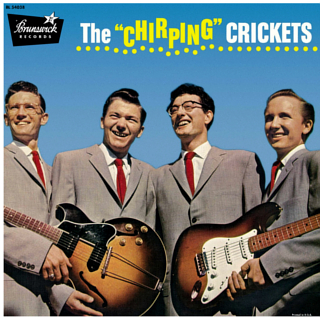
The "Chirping" Crickets

The Crickets
1957

Despite being of a similar vintage and style (in the broader scheme of things) as Johnny Burnette, this seems completely different. Burnette played rock 'n' roll, inspired rockabilly and probably remains a minority interest. Buddy Holly played pop, inspired The Beatles and is a legend.

That's not to say this album is particularly good, sadly. The classics - "Oh Boy", "Not Fade Away", "Maybe Baby" and "That'll Be The Day" - are fantastic, whereas the remainder of the album tracks are filler. In particular, the slower songs on this album drag, which is odd, given that Holly was capable of such gems as "Everyday" or "Words Of Love" (neither of which are on this album).

Realistically, this reflects the attitude to albums at the time, a decade away from considering them as worthwhile artistic artifacts in their own right. Why this album then appears in the 1001 Albums You Must Hear Before You Die is a bit of a mystery to me. Buddy Holly - with and without The Crickets - is an artist that really needs a Best Of to appreciate properly.

20/04/2012

Gunfighter Ballads And Trail Songs

Marty Robbins
1959

If I had to lay bets about the genre of music least likely to appeal to me, it would be country and western. Both kinds. And this album seems to embody all the aspects that irritate me: maudlin balladry, overwhelming sentimentality and an inexplicable obsession with a distant (and brief) period of history. Don't most people grow out of playing cowboys and indians by the time they're twelve?

So it comes as a complete surprise to me to find that I have heartily enjoyed this album. In fact it's probably my favourite so far of the albums from the fifties that I've listened to. I should learn to get over genre classifications. Or remind myself that, as Louis Armstrong said, there are only two types of music. This is the good kind.

My most common complaints about some of the music I've been listening to recently is the lack of proper tunes. This is not a charge you can level at Marty Robbins. Every single track here has a super, straight-forward, whistle-able tune that actually stays with you, accompanied by simple guitar, bass and drums. It might be simple but it is mightily effective.

Favourites? "Big Iron" starts the album and is a song of a ranger and an outlaw having a shoot out. The acoustic guitar strums in an insistent rhythm while the double bass thumps satisfyingly underneath it, while the story unfolds over it in a wonderfully singable tune. And so we find for the whole album. The songs are mostly stories: "El Paso" is the story of a man who kills and runs, but returns for his woman (and gets killed); "The Master's Call" tells of a boy who becomes an outlaw but is rescued by a vision of God, or Jesus, or something. All are blessed with superb melodies.

So, C&W, eh? Bring it on. Next stop: Hank Williams.

05/12/2011

Johnny Burnette & The Rock 'n' Roll Trio

Johnny Burnette & The Rock 'n' Roll Trio
1956

Contrary to my preconceived notions before I started on this project, music in the fifties was pretty sophisticated.  The arranging and recording skill behind acts such as Frank Sinatra and Ella Fitzgerald, or the sheer theoretical knowledge required to properly understand (let alone play) post-bop jazz like Miles Davis's The Birth Of The Cool or Charles Mingus's Ah Um must have been pretty daunting to anyone wanting to join in.  So the rawness of early rock 'n' roll like Johnny Burnette must have sounded as jarring and alien at the time as the punk rock of twenty years later.

Listening to it now, it sounds primitive.  The instrumentation is basic, just a couple of guitars, a double bass and a couple of drums.  The singing, in particular, is untrained, raucous and direct.  But it has an energy and urgency that is missing from the cool, restrained and (above all) professional music coming from the established artists of the time.

Maybe the iconic figure of rock 'n' roll is Elvis Presley (who also released his debut in 1956) but this album is clearly one of the formative roots of rockabilly (they even have a song called "Rock Billy Boogie").  I found it of more than just historical interest; it's very immediate and some of the guitar sounds are really grungy.  Good stuff.

03/10/2011

Julie Is Her Name

Julie London
1955

This is even more minimal than Black Coffee - just Julie, a guitarist (the legendary Barney Kessel) and a bassist (Ray Leatherwood). The tempo is equally downbeat, but for some reason this doesn't sound as smoky and late-night sultry as Peggy Lee's album.  It's still beautifully evocative of its era though, with a lovely romantic feel - like the aural equivalent of a soft focus lens.

The first song is the classic "Cry Me A River", which would justify the purchase of this album alone.  The rest of the songs are mostly standards, and my favourites are "It Never Entered My Mind" and "I'm In The Mood For Love".  The occasional forays into more up-tempo numbers are less convincing, because they highlight Julie's limited range and power as a singer.

Overall, I found this to be a bit backgroundy-muzak, which is a shame in some respects because it is worth listening to carefully.

This came on a CD with Julie Is Her Name Vol II (1958), an album in exactly the same style and equally pleasant.