Showing posts with label guitar. Show all posts

21/09/2025

Pedal Power 2025

Blimey, it's been over three years since I last surveyed my kingdom of effects pedals. I've been chopping and changing a lot, and of course, any pedal set up is ultimately completely dependent on the amp, speaker and cab they're running through, and it's taken me a while to properly realise this. It's only now that I have an amp and cab I'm really happy with. As such, it makes sense to talk about them first.

For some reason that I can no longer recall, about two years ago I got a bee in my bonnet about solid state amps. Valves amps sound great, but they are problematic - power hungry, hot, delicate and expensive. And despite the vast amounts of bullshit spouted about the supposed magical qualities of valves, there are a few people trying to promote the idea that a well designed analogue circuit - so not digital modelling - can achieve the same results and not just be for cheap practice amps.

The long-standing king of solid state is the Peavey Bandit, which has been gaining more respect over the years, and Orange have their Super Crush amps that are very well regarded. And around this time I started hearing more about Quilter amps, and it turned out that they'd recently released a smaller amp.

And so it was that I ended up buying - new! - a Quilter Superblock US, which, despite its size, is a 25W amp. Around the same time, I decided I should have a decent cab and so ordered a Fat Baby 1x12 from the excellent and super-helpful folks at Zilla in Cornwall. As you can see from the picture, the contrast between the tiny amp and the somewhat oversized cab is quite striking! The combination sounds fantastic: the base Superblock US sound is Fender-based, so the cleans are lovely, and when pushed with a drive pedal, it really rocks.

With the core sound established, I re-examined my pedal board. I already had plenty of options, so it wasn't a case of throwing everything out and starting again, just identifying what worked well. For a while, I went minimal: just two pedals and the amp, and in fact the Blackstar boost shown here wasn't really necessary, because the Line 6 HX Stomp provides a comedically over-comprehensive set of options. It's wired so that the signal goes into the Stomp, then the Superblock's pre-amp is in the loop of the Stomp, and then the Stomp is in the loop of the Superblock. The upshot is that I can use the Quilter's pre-amp or bypass it and use a Line 6 amp model, and choose which (modelled) effects go before and after each.

This provided an incredibly wide range of different sounds, what with something like fifty different amp models and several hundred effects to choose from. But I realised after a while that I wasn't really happy with any of the sounds; I'd spend more time fiddling with options than just getting lost in the music. I'm not sure if that's because I know there's always another thing to try, or because I just didn't like what I was hearing, not that I could tell you what it was I didn't like. So I retired the HX Stomp for now and tried again.

Going back to individual pedals has been a bit of a relief, surprisingly - there's a lot less range, but what there is sounds really good. Also, the Pedaltrain fits nicely on top of the cab, so I can either just leave it there or put it on the floor when I play.

The pedals then, in signal order:


Digitech Freqout
This is a brilliant pedal that I've had for a while, but hasn't been on any board I've documented for some reason. All it does - brilliantly - is mimic the sound of a guitar edging into feedback. It's a sound I love and it's hard not to over-use it. It has to be first in the chain in order to get the cleanest sound.
Cry Baby Mini (CBM95)
Some people find this version of the Cry Baby too small, but I don't mind.
Fredric Effects King of Klone
What's better than one Klon Centaur-alike? Two! A staple of my boards for a while now
Blackstar Dept. 10 Boost
I bought a lot of pedals over the last ten years, but none for about a year, and this last one. It was shown on (YouTube channel) TPS and compared favourably to a (much more expensive) Kingsley pedal on the guitar forum. When I found out Blackstar were selling an ostensibly £190 pedal direct on Reverb for £99 (they still are, actually), well, I couldn't resist. It's not a clean boost, but it's a lot flatter (depending on the EQ settings) than the Klone, and adds a nice crunch to any sound. And so, having said I wanted to avoid valve amps, I've ended up with a valve on the board anyway!
Tech 21 Double Drive
An old favourite now, very versatile. Sounds particularly good when boosted by either the Klone or the Dept. 10.
Strymon Ola
I fancied a decent chorus and when this came up secondhand, and knowing the quality of the Strymon stuff - I've had five of their pedals at various times - it was a done deal. The Ola isn't one of their more celebrated pedals and it's a bit of a one-trick pony (a bit like the DIG) but it sounds superb - well up to an Analogman Chorus I A/B'd it with.
BOSS GE-7 (modded)
A fantastic utility pedal. After this, we go into the Superblock's input, and then out of the effects loop into the ...
Strymon Brigadier
I've had (and still have) analogue bucket brigade delays, but this is a better all-round pedal. Sounds gorgeous. Strymon recently released the Brig, which supposedly has reworked algorithms, but I can't hear much of a difference.
Neunaber Immerse (mk 2)
I've not even considered another reverb pedal since I got this (blimey) over four years ago. Interestingly, Quilter recently bought Neunaber, which makes me wonder whether the excellent reverb in the Superblock is theirs.
TC Electronics Ditto+
A great little looper.

The little shaving cream tin on the board holds picks and a tuner - the traditional/cliché utensil for this is an Altoids tin but I have several of these spare. Do these need to be on the board? Debatable. But it keeps it all together.

06/03/2022

Pedal Power 2022

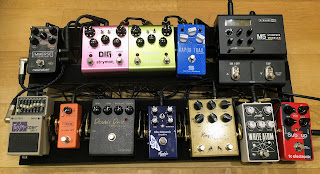
 Less than a month after I last reviewed my pedal board I decided I wasn't very happy with it. I'm not quite sure what prompted this any more, but out went about half a dozen pedals and in came at least that many again, quite a few bought brand new, and a whole new board and power supply. Since then it's changed slightly and, just in case this wasn't enough, I've recently assembled an entire second board. (Now I read this in black and white, it occurs to me that this might all be a little bit over the top ...) So although I normally review things once every couple of years, I thought this needed revisiting sooner.

What do you mean, seven gain stages
and five delays is too many?

First up, then, my big board. I wasn't particularly happy with the sound of my board last time, particularly the overdrive sounds, and I've been searching for my favourite delay sound for a while too. Let's go through it in signal path order:
Bright Onion Shifter Switcher Patchbox
The really posh pedal boards have built-in patch boxes, so that the pedals are always plugged in, and you just make your connections to the board as a whole via the patch box. I like this idea, so this achieves the same result. It's underneath the board at the back right, under the M5. It's also quite clever: the pedals for the front of the amp are patched in separately to the pedals for the loop, but if you only connect one in and one out, everything goes through one path instead of separate paths, which means I can use this with an amp that doesn't have a loop, without having to change anything. That's really helpful if I'm round at a friend's house using their amp.
Line 6 M5
A jack-of-all-trades pedal that's just too good to leave off the board. I really like the wah wah models (although see later on for my budget board!), the compressors are fine and I've been using the rotary model recently too. Since there's a whole section of delays in this thing, this counts as the first delay on the board!
TC Electronic Sub-n-Up
I originally used one of the octave effects on the M5 but I liked it enough to warrant a dedicated pedal. This has a surprising amount of variety in it.
Magnetic Effects White Atom
Now discontinued as the manufacturer has decided to move and stop making pedals. I really like the idea of this pedal, but in practice it's a highly competent but somewhat generic fuzz. It's not as massive as a Big Muff or as brutal as the SF300 (see below). I'll probably sell it at some point.
Fredric Effects King of Klone
I love the Klon circuit boosting anything, including itself, so this is a great pedal. A fixture of my big board.
Fredric Effects Blue Monarch
I'd never tried a Bluesbreaker style pedal before. This is actually more a clone of the Analogman Prince of Tone. Initially I thought it was great, but actually it's a bit too fizzy and polite for me - I prefer something with a bit more meat. Hence ...
Tech 21 Double Drive
I sold this about two years ago because I fancied something else, but then last year I saw a JHS video about under-appreciated pedals and realised I missed it. Luckily the guy I sold it to still had it and wasn't using it - so I got it back for exactly what I paid for it. Not letting it go again!
MXR Phase 95
Phaser is still one of my favourite effects, and one of the first I owned. This is a brilliant little pedal, better and more flexible than the Phase 90 (which they've ruined somewhat), and smaller!
BOSS GE-7 (modded)
Ideal and very necessary for sculpting tone (ahem).

This is the last pedal before the amp, if I'm running the following pedals in the effects loop.

Seymour Duncan Vapor Trail
I've tried various types of delay and analogue (bucket brigade) delay is my favourite. I've been through a bunch since I sold my original MXR Carbon Copy (mistake) and landed here, which sounds pretty much the same but has the advantage of modulation controls on the top (which is why I sold the CC in the first place). Somewhat underrated but a proper analogue delay - with all the limitations that implies as well. Which is why I also have ...
Strymon Brigadier
Analogue delay sounds awesome but it's either very dark, or noisy, and the delay time is limited. This is a digital model but for anything apart from the extremes of self-oscillation (which the Vapor Trail can do), this is superior to anything else: it's clean if you want it, massive amounts of delay if that's your thing, and incredibly musical.
Strymon DIG
So given that the M5 can do several types of delay and I have two separate analogue style delays, what's this doing here? It's a different sound which is sometimes very fun to play, and if you hook it up in stereo it sounds incredible.
Neunaber Immerse
Probably the best reverb pedal I've ever had. It does everything (even another delay if the previous four aren't enough) and has completely cured me of wanting another reverb pedal. Despite buying this for its plate reverb, it actually spends most of its time on the hall setting, which has subtle modulation and is absolutely fantastic.

What is also new is the board itself, which is a new Pedaltrain Classic 2, which is roughly the same size as the old board but has more usable space and, crucially, allows for a new Truetone 1Spot CS12 power supply mounted underneath, needed for all the higher consumption pedals.

So this is the state of the big board, and has been since roughly the end of last year. It can do loads and loads of different sounds and any modification - like the ability to run in stereo, for example - would be expensive.

So obviously, if my main board is so capable, I don't need another one, right? Wrong!

At the beginning of this year I had a couple of hundred pounds in my Paypal account from previous sales and for some reason I got the idea into my head that instead of searching for the next boutique beauty, I should see how far I could stretch my money. The core basics would be fuzz, overdrive, delay and reverb, with optional wah and wobble of some sort. I was trying to find pedals that are generally agreed to be good pedals, not just good for the money. And although I'm not a gigging musician, I wanted a board that would be reasonably versatile for if I was jamming with a friend.

Mainly, I think it was an excuse to do some shopping without completely breaking the bank, but it turned out much better than I expected - in some respects, it's a better board than the main board, and some of the pedals would absolutely not be out of place in a pro setup. Here's what we have (right to left, signal path order again):

The bargain basement budget board
Cry Baby Mini CBM95
A Cry Baby Super was my first ever pedal and this is probably even better: true bypass, three voicings, an adjustable pedal feel and it fits on a board properly. Sounds perfect to me - just like a Cry Baby. I settled on the vintage voicing but the low voicing is really nice too. Bought secondhand for a very nice price.
Behringer SF300 Super Fuzz
A blatant BOSS FZ-2 Hyper Fuzz clone, this is an absolute budget classic, not just an acceptable version of something more expensive. I got this from the forum but it's only £18 brand new. Brutal at high gain, with an occasional hint of octave fuzz, it also works as a good distortion with low gain and wedged between modes 1 & 2 (a party trick the BOSS can't do), plus it serves triple duty by acting as a decent clean boost.
Caline Pure Sky
Another budget classic, this is generally regarded as a very, very good Timmy clone. I've never played an original but this is what I was hoping for when I bought the Blue Monarch: a nice rich overdrive, even at low gain, adding some thickness to the tone, and also very nice boosted. Just great and incredible value new, let alone the tiny price I paid secondhand.
MXR Micro Chorus
Originally I bought a Behringer chorus (same series as the fuzz) but it sounded a bit generic - perfectly acceptable but the least inspiring pedal on the board. Then this came up for about a third of its new price and it was worth it: played side by side, you can really hear the difference in quality. I also love that I can adjust the one control with my foot.
Xvive Echoman
There was a lot of hype about these a few years ago, but it's died down somewhat. Supposedly designed by the same man that designed the legendary EHX Memory Man Deluxe, this has some of the same flavour, but probably some of the same drawbacks - mainly, it's noisy. This wasn't such a bargain, although it was still a decent price. If I was a bit more patient, I would have waited for a cheaper, "analog voiced" delay, of which there are plenty. That said, it's a nice sounding pedal.
TC Electronic Skysurfer
TC's "smorgasbord" range includes some real value and I think this is one - particularly given that it was half the price for me because I used some of my loyalty points at Andertons. Simple but effective reverb that does what it says.
The board itself is home-made from a piece of wood I had lying around that was exactly the right depth and just needed cutting to length. I used a hole saw on my drill to create "rails", and I put some feet on too. The power is from a daisy chain supply and the patch cables were ones I had lying around.

Total cost: £199

09/06/2021

Pedal Power 2021


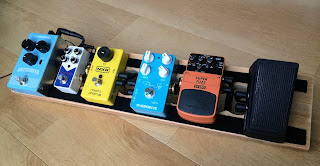
Amazingly, another two years has (almost) passed since I last reviewed my pedals, and there are quite a few new purchases, so it's definitely time to do it again. This obviously doesn't include pedals that have come and gone in between times, including the classic pairing of the Strymon Flint and Strymon El Capistan (so at one point I did in fact own four Strymon pedals), the Source Audio Nemesis, Catalinbread Talisman and Hamstead Odyssey - all top notch pedals, but not quite right for me.

One thing that's fairly obvious when reviewing the previous three of my pedal board posts is I have been gradually drifting towards more expensive items. In 2015 I owned two that cost more than £100, with most of the selection being firmly at the cheap and cheerful end of the market. Today there are three that I paid over £200  for (two of which were secondhand) and three more that would have been over that much new. That said, all but three of these pedals are pre-owned, so in theory I am improving value for myself that way!

Anyway, here they are, in signal path order:

Bright Onion Mini Looper [1]
Still being used as a patch box and mute switch, hasn't shifted since last time.
Line 6 Expression pedal [2] and Line 6 M5
Also unmoved in over two years. The effects I use most often are an octave down, a chorus and a wah. Since collectively those would cost significantly more than this, and take up more space, it stays. Although I am tempted to get a TC Electronics Sub 'n' Up for the octave shenanigans.
Fredric Effects King of Klone [4]
The Electro-Harmonix Soul Food had been on my board for ages, but I'd been wondering about getting a "better" Klon Centaur clone, and this came up at an excellent price. It's not better than the Soul Food it replaced - or worse - but on the other hand this is two Klon circuits in one box, which sounds excellent. I should have hung on the Soul Food though, it was very good at boosting things and had its own character.
BOSS OD-200 [5]
My most recent purchase. I'd been wondering about different flavours of overdrive and this pretty much does it all. I'd tried a Hamstead Odyssey, which is a really nice pedal that has a fair amount of variety, but it had a top end fizz I couldn't dial out - although in hindsight that might have been the H&K Tubemeister amp, which has since been replaced by a Yamaha THR100H. The OD-200 digitally models a dozen drives, fifteen boosts and allows a drive and a boost to run simultaneously. Incredibly versatile, although I haven't played with it enough to know whether it's a keeper.
BOSS GE-7 (ThorpyFX modded) [6]
I had a Mooer Graphic-G which was very compact but didn't get much use the frequencies weren't quite right, and was a bit noisy. The GE-7 is the industry standard, although it's also generally considered to be improvable itself in the noise department, which is why modded versions like that by Analogman are highly sought after. I assume this has much the same updates, in this case done by Adrian Thorpe. Anyway, it's very good. I also like having a "proper" BOSS pedal on the board - it's a design classic.
Eventide Rose [7]
I love delay. My first was a Frontline FD-1200 Digital Delay which got lost ages ago, but my first in more modern times was the MXR Carbon Copy. That started my descent into a bit of a rabbit hole which has ended up here (so far). The Rose is a digital take on a bucket-brigade style delay, but with way more features. It sounds excellent - you'd expect nothing less of a company with the pedigree of Eventide, of course - but it's too new to know whether I'd use all of its capabilities. I suspect that I won't, which leaves me wondering again whether I should have just kept the Carbon Copy! (bit of a theme developing here ...) Fun to try all these things though.
Strymon DIG [8]
This has three different digital delays which do sound different, albeit only slightly. So in practice it's a bit of a one-trick pony - although in fairness, it's a hell of a trick. If I want a single delay I usually go for a more analogue sounding delay like the Brigadier or the Rose, so all this gets used for is bad Edge impressions, which is enough to keep it on the board!
Neunaber Immerse Mk II [9]
I also love reverb, although for a while I decided that whatever is in the amp is enough. However, I really missed the adjustability of a pedal. I tried the Source Audio True Spring, which sounded superb but is only spring reverb (duh) whereas I like plate reverb more. So I moved on the to Strymon Flint, which stayed until very recently and saw off the Catalinbread Talisman. It's excellent but perhaps a little dull, and I couldn't use the tremelo effectively either. So when the Immerse came up on the forum, I snapped it up. So far I'm loving it - loads of different reverb options, all of which sound luscious. Plus it has an "echo" option for when two other delays aren't enough.
Hotone Wally+ Looper [10]
I've had a looper on my board since I inadvertently acquired one in the TC Flashback X4. The BOSS RC-1 wasn't as usable as I expected and definitely muffled the tone, so on a whim I bought this, the smallest looper I could find. It's tiny (see pic) but it has eleven slots for loops and can record something like thirty minutes in each of them. Needless to say, all I use it for it recording simple chord progressions for improvising over. Worth having though, and takes up almost no space on the board. Hotone used to do a whole range of pedals this size - it's tempting to do a whole board with them and compare it!
Tech 21 Sansamp [11]
I've said a few times already that there are pedals I shouldn't have sold, and that's why I won't sell this. It's a classic, it's great at what it does and it was great value for money.
Ken Multi MCP-7 Compressor [12]
I think the only time this comes out of its box is for family photos like this! Pity, as it's a perfectly functional, if shameless, copy of a BOSS CS-2, but the M5 has three or four compressors in it that I'd use instead if that's what I wanted. Worth nothing though, so it won't be going anywhere.
BOSS LS-2 Line Selector [13]
Another utility pedal that is a tool in the box for those moments when I need to split a signal. Have to admit I haven't used it recently though.
Strymon Brigadier [14]
As mentioned above, I got the MXR Carbon Copy and loved it. But inevitably, I wondered if more controls would be better, so I sold it for the Carbon Copy Deluxe, which was a disappointment. So basically I've been looking for something that sounds like the CC, but with more control over the modulation and the feedback. I had the BOSS DM-2W (lovely but lacking modulation on the repeats), the Strymon El Capistan (tape delay not really my thing), this and the Rose above. The Brigadier sounds excellent but the mod control could be better and the oscillation is obviously digital. I suspect this is leading me back to properly analogue delay again - either another CC, or something even more expensive like a full-fat Deluxe Memory Man Deluxe (the 1100 TT is probably the best bet). 
Not pictured (but talked about last time):
  • Fredric Effects Unpleasant Companion - up for sale but I might change my mind as there has only been one inquiry in over a month.
  • Cry Baby Super

04/08/2019

Pedal Power 2019

Comparatively, it's a cheap hobby. Honest darling!

I was re-reading my 2017 pedal survey and was honestly surprised by how many of the pedals I had then have been sold on. I genuinely thought I'd stopped chopping and changing so much! It's obviously time to review again, in what's becoming a biennial exercise. So I gathered them together on our nice kitchen floor (that green carpet is just horrible) and did a family shoot.

At the top are the pedals currently in daily use on my board. Those on the floor are in a cupboard and not used as much. The board itself is a Palmer Pedalbay 60 - not the most glamorous bit of kit but invaluable, even for a strictly home guitarist like me. Because it's all wired up, I just plug a couple of cables in and I'm ready to play. This is helped by a Voodoo Labs Pedal Power Plus, under the board, giving power to everything.

All right, that's the dull (but very useful) stuff taken care of. Onto the pedals themselves!


The board

In signal path order:
Bright Onion Mini Looper [5]
This is being used on the board solely as a patch box, otherwise getting the guitar lead into the M5 is awkward. However, it functions as a mute switch for the whole thing as a nice side-effect.
Line 6 M5 Stompbox Modeller [9] & EX-1 expression pedal [10]
"100 effects pedals in 1", they say. I'm a bit ambivalent about this, because I am not patient enough to go through them all meticulously, so it's a little wasted on me. However, for £70 (s/h) it's an absolute bargain and although the quality varies somewhat, all the effects at least good and some are excellent. Consensus on the forum seems to be that the delays and reverbs are very good, but actually I prefer to get my delay from dedicated units. However, I quite like the drives and the Cry Baby Super model ("Fassel") is really close to the real thing. So this regularly gets used as a wah (there are about 5 other wahs also!) and occasionally as something else if I need, say, a chorus, a phaser, an octaver or something else. Having it around gives a lot of options, needless to say.
Electro Harmonix Soul Food [8]
A staple of my board. Every drive I've tried sounds better with this kicking it up the arse. I am very tempted to try a "better" Klone to see if it actually makes a difference. The Wampler Tumnus is very good ... but would you really notice?
Tech 21 Double Drive [7]
This was up for sale earlier this year. No bites though, so I put it back on my board. My thinking was that I would be fine with the amp distortion, but this gives me a lot more options. It's really good - hardly worth letting go for the sake of £40-ish. Currently it's going head-to-head with the ...
ThorpyFX Gunshot [6]
I've never had a "boutique" overdrive and fancied seeing what the fuss is about. The Gunshot gets a lot of love online (as do all ThorpyFX pedals), but possibly it wasn't the best to start with, as it's supposed to be what the cognoscenti call a "MIAB" (according to the man himself) and also loosely based on a Tubescreamer, which doesn't really suit my amp, a H&K Tubemeister 18. That said, the pedal has a lot more range than your usual TS clone. As for whether boutique is worth it - well, predictably, it's about small gains. Having had a chance to try it slightly louder than normal, I think this would be fantastic on a gigging board - it really cuts through and has a lovely quality. At the volumes I normally play and record at, however, I am concerned it's going to be a bit lacklustre.

That's all the pedals in front of the amp. In the loop are: 
BOSS LS-2 Line Selector [4]
This is a great multi-purpose pedal. I've used it to run parallel distortion/fuzz, which was good fun. Classically it's used to switch between two separate banks of effects. Right now, it's here to take a feed after the pre-amp but before the delay & reverb effects, and send it into the audio interface. Then I can get the same approximate signal but use delay and reverb in the DAW, while still playing with delay on the signal I can hear.
BOSS DM-2W Delay [3]
I replaced the MXR Carbon Copy with a Carbon Copy Deluxe, but was disappointed in it. So I got this instead. It only came up on my radar recently, for some reason, but someone was selling so I grabbed it. This is the "Waza-Craft" edition, which adds a couple of useful features (longer delay, split dry/wet & expression control for rate) and uprates all the components, apparently. Anyway, it's a superb analogue, bucket-brigade delay. The only thing I wish it had is modulation - although you could add it in if you wanted, by using the separate wet-only output and recombining with the LS-2 (say).
Strymon DIG [2]
I sold the TC Flashback X4 and fancied a boutique delay of some sort - and, to be honest, I fancied a Strymon. They do a number of delays and it was a toss-up between this and the Brigadier - and this came up. It also has two delay engines, so that sold me. Instant Edge! A great sounding pedal, although I can't really tell much difference between the three models.
BOSS RC-1 Loopstation [1]
Having sold the TC Flashback X4, which I as often as not used as a looper, I needed a looper for practice, and this is as straightforward as any. The TC Ditto would have been smaller though.

The others

Dunlop GCB-95 Cry Baby [11]
Someone at work was selling this for a tenner. Bargain! It was missing the rubber stops underneath but I found a pack of replacements at Strings Direct. The movement is a bit shallow and the sound isn't quite the same as my Jen Super but it's OK. However, it's not being used because, as I say above, the M5 works just as well.
MXR Carbon Copy Deluxe [12]
This has been a real disappointment. I loved the original Carbon Copy and the Deluxe looked to have the additional features I wanted: tap tempo and expression control. However, the sound isn't there any more, the controls have very little range and you can't control self-oscillation with an expression pedal because regen isn't controllable with it. It's being sold.
Mooer Graphic G [13]
Useful for specific sounds, although, again, the M5 has various EQ options also, so not used very much.
MXR Phase 90 [14]
Phase is my most-used modulation and I like having it after distortion or fuzz (à la "Eibhli Ghail Chiuin Ni Chearbhail") so this has actually now made it back onto the board in place of the Gunshot.
Moog EP-3 expression pedal [15]
Useful with various effects - it works nicely with the DM-2W and the DIG. Useful for special effects.
Jen Cry Baby Super [16]
I've written about this before and it still needs a new pot. Semi-seriously considering selling it to someone who would actually use it.
Tech 21 Sansamp ("Classic") [17]
I'd been on the lookout for one of these for a while. Apparently it's well used in professional circles for recording bass guitar, and so I tried this, with some success if I say so myself. It also does good guitar sounds. It's very flexible. I'd say overall the sounds aren't super-refined - or maybe I just haven't found the right combination of settings - but for a hobbyist recording, it's superb.
Fredric Effects Unpleasant Companion [18]
Bonkers fuzz, but again probably superfluous for the amount I use it and the fact that the M5 has a bunch of them.
BOSS FB-2 Feedbacker/Booster [19]
Another niche pedal, this time with no direct equivalent that I am aware of. Kept for those occasions when I want to simulate feedback. As a boost, it's somewhat industrial sounding.
Handmade Phase 45 clone [20]
Really smooth phase sounds, more subtle than the Phase 90.
Ken Multi MCP-7 Compressor [21]
Worth nothing and probably not worth keeping (again, given I have the M5) but not worth selling either.
Mad Professor Deep Blue Delay [22]
This isn't actually mine, it belongs to a friend. I did a back-to-back comparison with the DM-2W, and preferred the BOSS. It's a good sound though.
Korg AX1G [not shown]
My first multi-effects and, again, not worth selling really. Not sure what I'd ever use it for though.
Pedals that have come and gone in between this update and the last one are surprisingly few: a Source Audio True Spring (great pedal, but I prefer plate reverb) and a Hudson Broadcast Dual (didn't suit my amp). I bought both of these new, which was probably a mistake, caused by impatience mainly!

20/05/2018

Solo of the Month #36

The backing track this month sounds like something from a sixties spy thriller (although only to me apparently, judging by the other entries). I'm thinking of things like Get Carter (not actually from the 1960s, I know), The Persuaders, The Ipcress File and so on.

Hence I have attempted to create "Theme from Unknown Man", the title sequence from a little-known TV series shown for 3 weeks only on ATV Midlands in 1969.

In my simplistic way, "spy theme" boils down to semi-tone intervals and lashings of plate reverb. So I fiddled around in Am and added grace notes a semi-tone above or below where the main notes were until I got a melody that sounded suitably mysterious. I played the first half in 3/4 across the 4/4 beat to make it sound interesting, and the second half in 4/4, but shorter phrases, to make it sound like it was going faster.

Production wise, this was straight into the audio interface and all effects in the box: JS 1175 compressor (one of the many compressors in Reaper), a bass amp plugin that came free with Computer Music, TAL's Dub II delay, Acon Digital Verb (also free with CM), and a (free) valve exciter thing to sprinkle a little pixie dust over the top. (I haven't gone for many paid plugins yet!)

24/03/2018

Solo of the Month #34


There are only three chords in this month's backing track, and the third one only crops up twice anyway. That doesn't mean it sounds monotonous though, it's a jazzy, minor feel vamp, loosely based on the progression from "Unchain My Heart".

The root key here is Gm, but the other chords bring in other notes and scales and - as ever - I don't have the theoretical basis to be clear what would be "right" here. I little improvisation over it shows that keeping in Gm pentatonic sounds about right, but a bit dull. The other approach is to work out what notes are in the chords and work with those (in fact, B, whose knowledge of music theory is better than mine, suggested this as well). I probably should have done this to advance my knowledge and understanding, but I didn't have the time and couldn't really be bothered.

I experimented for a while with variations of the chords at different positions to see if the transitions inspired anything, but couldn't quite make it work to my satisfaction (one of the other participants did the same and ended up with a gorgeous sounding spy theme, much better than I would have been able to do). However, during this, I hit on the idea of playing with octaves, and decided to make this the basis of my solo.

I played through the track multiple times and eventually the shape of the solo worked itself out. So I suppose we could consider it "composed" rather than improvised. I recorded it in sections so I wouldn't forget it, and then played along with myself to get the whole solo in my head. I liked the sound of this, so I decided to have two guitars at points. The important thing there is that the two guitars are two different takes, not just the same take duplicated, because the tiny differences in timings and intonations is what gives it a sense of space.

The final take is a single pass through, since I'd learned the whole thing, and the second guitar is used to "pop" some of the key notes, as well as providing a harmony in the last four bars. Both guitars were recorded dry, just through the amp. I added a bit of EQ and compression in Reaper, but no reverb since it sounds nice without it. I used a touch of reverb to the harmony guitar to give it a slightly different position in the track. Finally, when it got to the harmonies in the last bars, I panned the guitars slightly left and right, to emphasise the change.

This was a bit of a struggle, mainly because I couldn't hear anything over the track for a long time. But the end result, a product of a solid three hours right at the end of the time allowed, is something I'm rather pleased with. It's understated and works with the track rather than sitting on top of it, I think.


25/05/2017

Solo of the Month #27

May 2017

We have a slice of what is probably a middle of the road rock ballad this time round. As the middle eight finishes it sounds like someone should be chiming in with "You know I love you, I always will ...".

The chord progression is simple: G, C, D. Maybe too simple. I found it really hard to hang any kind of interesting idea onto this. Also, I was slightly put off by the fact that the obvious - no, the cliched - sound over this is a smooth overdrive, which is what I expected everyone else to use, and I know there are people who are much better at that kind of playing than me. The main thing I can do is use my imagination to come up with something slightly different.

Since this is in G, I normally think in Em, in terms of shapes on the fretboard anyway. This also means that quite a few of the harmonics at the 12th, 7th and 5th frets will be valid notes in that scale. It turned out that the smooth overdriven sound (EXH Soul Food on max boost into the Tech 21 Double Drive running on full "class A" gain, and the MXR Carbon Copy providing some subtle delay) made the harmonics sound pretty epic, so that gave me a good intro. Then a simple repeated riff using basic notes from the chords did the rest.

I don't think it's particularly inspired but then, if I'm honest, I don't think the backing track is either. Apparently it's the middle eight from an existing full track, with the vocal and solo stripped out, and I think some of that context would have helped inform the solo. Anyway, here's what I ended up with.

18/04/2017

Solo of the Month #26

April 2017

This month's backing track is a medium paced, poppy sort of chord progression to start with, but then in the second half it moves through a more jazzy sequence of chords, which all resolve nicely back to the original.

I can usually work out what the base key of a track is, but this one had me stumped and, for the first time, I had to ask what the chords were. The first section is straightforward enough, it turned out (Emin7, A7, Dmaj7), but the second was completely beyond me. Still, once I knew the key, I could do the rest by ear, since I don't really have the theory to work out the "proper" notes.

I have a new toy, a Frederic Effects Unpleasant Companion (mk II), which is an absolute fuzz monster, so whatever I did was going to include that if at all possible. I had Ernie Isley's superb work on "Summer Breeze" and, in particular, "That Lady" in mind, and the simple signal chain of the Unpleasant Companion and an MXR Phase 90 gives something very close to that tone.

Sometimes it takes me a long time to work out a few lines for the solo, but this was a short piece with two clear sections and it didn't take long at all. A little practice to get it all in one go, and I was there.

I recorded it without reverb and added it in Reaper using the TAL Reverb 4 plugin, which is a nice and simple, to give a properly spacey feel. Finally, I'd fluffed the ending very slightly by not allowing the note to ring as long as I wanted, so I added a synced delay (iZotope DDLY plugin) on the last couple of seconds to extend it slightly.

Here's the final result:


09/04/2017

Pedal Power 2017

Nearly two years ago, I surveyed my effects pedal estate. Here's an update, and what's striking (to me) is how much has changed. Gone are a few old favourites I'd hung to for years, decades even - sacrificed to the obsession with new things (and the realisation that I never used them). However, I haven't bought anything new for months so I thought it was worth documenting what I have.

Cry Baby Super Wah [1]
This now needs a replacement potentiometer, but I'm somewhat nervous about doing it myself. If it was working properly I'd probably use it more.
Korg AX1G [2]
I've had this multi-effects box for ages, but I forgot about it last time, because I hardly ever use it. It was cheap and cheerful at the time, and now it seems very out-dated, but it offered a lot of bang for the buck, including as it does a bunch of simple but effective settings and an expression pedal, in a small footprint. Good fun. I can't remember where I got this or how much it was though.
MXR Phase 90 [3]
A simple, good quality effect. Adds a nice, certain something to the sound.
MXR Carbon Copy [4]
This is always on my board and has in fact supplanted any chorus pedals, because I prefer the sound of the delays being modulated rather than the direct sound, and it's a more subtle and very good quality chorus. Also fantastic as a simple, longer delay on lead lines. A modern classic.
BOSS FB-2 Feedbacker/Booster [5]
Despite what it says, this isn't a Metal Core, but an FB-2 with a replacement switch cover because the old one was broken. The FB-2 is something of an unappreciated pedal and it's tempting to say that if a boutique company came out with it now, it would get rave reviews. As a boost, it's very versatile, and the ability to add sustaining feedback at any volume (or even at no volume, via the amp's direct output) is great.
Mission Engineering VM-PRO [6]
A buffer and volume pedal. Somewhat expensive for what I needed really, but it's wonderfully solid and the action is super-smooth. Pro quality.
Moog EP-3 [7]
A few of my pedals have the ability to use an expression pedal, so eventually I caved in and went for this very reasonably priced example. Great fun with the Pitch Fork, which basically turns it into a Whammy.
TC Electronic Flashback X4 [8]
Having bought the Carbon Copy [4], I realised that, while it's a great pedal, what I wanted for some things is a longer delay. This has a number of different delay types, including a modulated 2290 (TC's famous rack delay), multi-tap (instant Edge!) and a looper too, which is good fun. It's rather big and I can't figure out how the expression pedal is supposed to work with it, but the delays are superb and you can edit sounds via the PC app, so it's incredibly versatile.
TC Electronic Hall Of Fame [9]
I wanted a bunch of different reverbs and this just does the job. I keep the reverb on the amp off (it's digital anyway) and run this last, in the loop. Originally I'd bought a HOF Mini, which is great if all you want is a "set and forget" reverb sound, but I like being able to adjust things more. This also works with the TC PC app.
Electro Harmonix Soul Food [10]
I think this is a bit of a modern classic, for all that it's a copy(ish) of the Klon Centaur. It adds a certain something to any sound, whether as a clean boost or adding "more" to another drive. The one thing I am not as keen on is its standalone drive sound, which is a bit harsh.
BOSS TR-2 Tremelo [11]
I was specifically after a square wave tremelo, which is why the Joyo trem I had last time got sold on. This BOSS model is simple but effective, and can do a basic amp-like, subtle trem, or an aggressive hard choppy trem. Ideal unless you're after something really different ... like the Super Pulsar [17].
Tech 21 Double Drive [12]
I saw this up for grabs on the board and it had been around for a while with no takers. Tech 21 isn't one of the favoured brands of the board (it definitely does have favourites), which must account for it, because it was an absolute bargain at £45. It's a superbly versatile overdrive that (along with the amp drive) has pretty much removed any desire for more drive pedals.
Mooer Blues Mood [13]
I bought this drive new, which was a mistake, because it was expensive, and it turned out I didn't really need it once I'd bought the Douuble Drive [12] a few weeks later. I've had it up for sale for a while but no-one seems interested - odd, because the BOSS Blues Driver is a board favourite, and this is a copy of it. Still, while I have it, it's another option.
Electro Harmonix Big Muff Pi Tone Wicker [14]
Everyone needs a fuzz and a Big Muff is where you start. Does what you expect.
Electro Harmonix Pitch Fork [15]
Multiple intervals - octaves up and down, 3rd, 4ths, 5ths etc. Great fun and, with an expression pedal, much like a Whammy. A bit digital in nature but some very cool effects.
Voodoo Labs Pedal Power 2 Plus [16]
Once you have this many pedals, particularly the higher-draw digital pedals like the Flashback [8], things can start getting a bit noisy with a daisy chain power supply. This does the job perfectly. Expensive but absolutely worth it.
Electro Harmonix Super Pulsar [17]
Only a couple of weeks after I bought the BOSS Tremelo [11], this came up second-hand. I'd been wondering about getting one for a while and I couldn't resist. It is incredibly flexible - as well as sine wave, triangle wave and square wave tremelo, you can make it work to a pattern you define, it can change depth or speed based on the volume of the guitar ... and it can take an expression pedal too. I haven't managed to use it in a track yet though!
Mooer Graphic G [18]
I saw Dan & Mick on That Pedal Show discussing graphic EQs, and then this came up in the classifieds. Pretty close to the industry standard BOSS pedal in function but nice and compact, and useful tailoring a tone.
Bright Onion Pedals Mini Looper [19]
Simple and effective.
3Leaf Audio Proton [20]
A bit of an indulgence - a superb example of an envelope filter, but quite niche. Popular with bass players, apparently.
Phase 45 Clone [21]
A very subtle but nice phase sound, with a mod to kinda do a Univibe sound.
Ken Multi MCP-7 [right]
Bought new from Maplins in the late 80s for about £40 (equivalent to £80 now), this is obviously a BOSS CS-2 clone but in all grey plastic. I hadn't used for literally decades until recently when I tried it - and it still works, and surprisingly well. Definitely worth keeping for those occasions when I want a compressor.
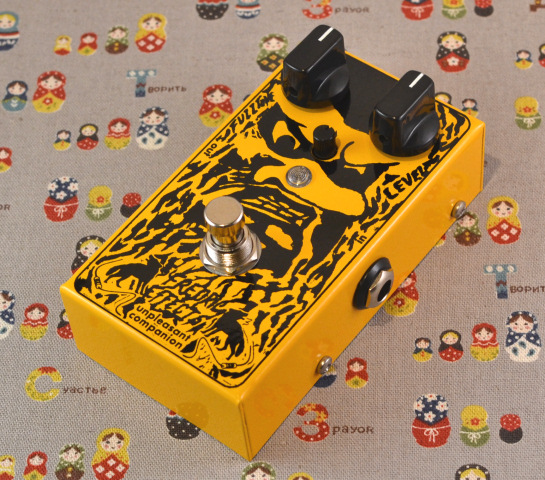
Frederic Effects Unpleasant Companion [product page]
My most recent acquisition is this completely bonkers fuzz, based on the "classic" (it says here) Shin-Ei Companion FY-2 Fuzz. Whatever. Far wilder than the Big Muff, but a fantastic "guitar about to explode" sound. 


Shopping 8 April 2017

Retail therapy

I haven't been listening to previous purchases as much as I expected, and probably haven't given them enough of a chance if I'm honest. So this time round I decided I would buy fewer albums and divert some of the cash into a pedal (or two) on Denmark Street. Nevertheless I still found myself browsing and taking a chance on a few albums. Here's what I ended up with this time:
Green Onions by Booker T. & The MG's (1962)
Soul Limbo by Booker T. & The MG's (1968)
I have McLemore Avenue by these guys, their own take on Abbey Road, and it's nice stuff. I thought a couple more in the same vein wouldn't go amiss.
Whirlpool by Chapterhouse (1991)
A shoegaze classic of course, but one that I don't really know, as evidenced by the fact that when I got home I realised I already owned it. Doh!
Garlands by Cocteau Twins (1982)
Early 'Twins that I don't have in my collection, despite having been a big fan for a long time.
Wheels Of Fire by Cream (1968)
Odd half studio, half live double album. Some great tracks but feels a bit contract filler to me.
Crosby, Stills & Nash by Crosby, Stills & Nash (1969)
A classic album, which is probably why I already own it. I must be getting old.
Alice's Restaurant by Arlo Guthrie (1967)
I've known this for ages thanks to dad, and it's a bit of a classic, or at least the title song is.
The Inner Mounting Flame by The Mahavishnu Orchestra with John McLaughlin (1971)
This could be either superlative, influential guitar jazz-fusion or utter tripe.
Octahedron by The Mars Volta (2009)
Modern prog, as far as I am aware.
No Room For Squares by Hank Mobley (1963)
I'm a sucker for Blue Note covers. Hey, who isn't?
A Moon Shaped Pool by Radiohead (2016)
One of the finest bands ever, full stop.
I Wasn't Born To Lose You by Swervedriver (2015)
Swervedriver have possibly the best name in rock, and a great back catalogue. Whether this reunion matches up remains to be seen.
Future Disco Vol. 8 - Nighttime Networks by Various Artists (2015)
Can't go wrong with a bit of disco, although I imagine this isn't really the same. Happy to have a listen at £2 though!

What pedal did I buy, you ask? Well, thanks for asking. After spending an enjoyable hour or so browsing along Denmark Street (possibly for the last time ever if what I've heard about it's redevelopment is correct), I splashed out on the utterly bonkers Frederic Effects Unpleasant Companion, a superb remake/update of the "legendary" Shin-Ei FY-2 Companion Fuzz (no, I'd not heard of it before either).

26/03/2017

Solo of the Month #25

March 2017

Here we have a simple 4 bar repeated pattern in E major, with a rock 'n' roll feel. It seemed to call for a rockabilly style, which is unfortunate since I can't play that at all.

In fact, the first question for me was whether I should use a major or minor scale. The track itself is purely major chords, but a major scale felt far too polite and not rock 'n' roll enough. A minor pentatonic isn't "right" but it does fit with the expected feel of a piece like this, so that's what I went with.

To give it the right sound I set up a slapback delay on the MXR Carbon Copy, with lashings of reverb from the spring emulation on the TC Hall Of Fame, and a single coil (tapped) setting on the neck pickup which gave it the right wirey-ness.

I worked over the track many times, making up for a slight lack of ideas by repeating a few notes over multiple changes (I'm sure I've heard Rory Gallagher do this ...). I particularly struggled with some of the quicker playing at about 38 seconds, but I was pleased with my ending. Sometimes I piece the solo together from multiple takes but this didn't have any gaps, so I had to practice the whole thing enough to get it acceptable when played right through. Once recorded, I just balanced the levels a little in Reaper and that was it.

And et voila:


I didn't do the two months' SotM before this, due our kitchen refit - the first I've missed in almost two years. The amp and pedals were packed away, but I still intended to record it with an amp sim in the box. In the end I just didn't have time.

21/12/2016

Solo of the Month #22

December 2016

Often the biggest influence on what I choose to play over a solo is the presence of a new toy. In this month's case, it's a very simple one: an expression pedal. Attached to the EHX Pitchfork, it makes it into a Whammy-style effect, and huge amounts of fun.

So it was already on the board when this rather nice backing track came up. It's got good dynamics, it's well recorded and there's some lovely little details going on. In fact, at nearly two minutes and with a clear verse/chorus structure (albeit one that cuts off rather suddenly), it's more like recording an instrumental than a solo.

After a bit of experimentation I settled on a compressed driven tone, using the EXH Soul Food into the drive channel of my amp and the internal gain boost on as well. I had a verse part and a chorus part and to add interest I used the expression pedal with the Pitchfork to sweep up an octave to the chorus, up another octave in the middle of the chorus, and down again at the end. The very high octave parts in the first chorus sounded a little thin, so I doubled it quietly an octave below. Then for the second chorus I recorded a harmony part, mostly fourths - basically, the same pattern but a string higher.

Recording this was straightforward, particularly since I did it in several parts, but this probably ended up being the most complex "production" in Reaper yet. I ended up with eight tracks (plus one for the backing): the guitar parts themselves, plus separate tracks for delay and reverb and a bus track to bring it all together. It was recorded dry, so I routed all the guitar parts through the TAL Reverb plate emulation plugin. I also wanted delay, but at different levels for different parts, in particular the long downwards glissando at the end of the first chorus. Here, a big modulated delay made it sound very other-worldly. It's using the superb PSP cmDelay (a cut down version of their Stomp Delay that was given away with Computer Music).

The guitars were routed in parallel through the delay and reverb, not in series, and brought together on a bus so I could control the volume easily. I put automation on the delay volume to bring it in and out where I wanted it. The reverb was as much because when the delay kicks in half way through the first verse, it makes a big difference to the sound, and the reverb cushions this slightly. However, it does have the effect that when you first hear the guitar, it does sound a bit like it's in a tunnel. I wasn't sure how to prevent this, but it does all come together later.

I'm quite proud of this one. It got some nice comments during the voting, including top marks from the guy who had recorded the backing track in the first place.


22/11/2016

Solo of the Month #21

November 2016

A first this month: the solo section from a well-known classic. One of the players on the forum has been recording a very close version of Ace's "How Long". mainly (as far as I can tell) to learn the track for live performance.

I thought the challenge for everyone on this one would be to avoid reproducing the original solo, unconsciously or not. But when I went back to listen to it, I realised I didn't know the solo at all, even though I'm very familiar with the song. It's Paul Carrack's wonderful vocal I remember, and the lovely plodding bass that introduces the track. The solo seems like it belongs in a different song.

I was also surprised to find that most other participants in the challenge didn't know the song at all. That freed them to produce some interesting solos, but - for me, anyway - ones that would have entirely failed to work in the context of the overall track. My personal challenge, then, was to try and do something that could be fitted into the original song and not stick out.

Having some context was a nice change, actually. It meant that the melody of the verse could be used as a jumping off point for the solo. I dialled in a gently overdriven tone on the amp, and recorded it in two sections. I added a bit of EQ to thicken up the tone and gentle reverb to place it in the mix. The master had Melda's MLimiter on it to punch up the overall sound. And here it is:


22/10/2016

Solo of the Month #20

October 2016

I wasn't quite sure what to make of this month's backing track. It is quite sparse and would probably lend itself to a number of different styles. It didn't help that I wasn't really feeling very inspired generally, and unfortunately this track didn't inspire me either.

I tried a number of different options and ended up with a main theme that used some wide intervals for interest. The tone was a general purpose driven tone with a delay on it from the Carbon Copy, synced as best I could with the beat. I had to stitch together a couple of takes to get it right, which was annoying as it wasn't actually that difficult, but oddly the one glitch you can hear (at about 0:37) was due to me making a very slight mistake on fretting a note! At 0:46 I switched to the bridge pickup to vary the sound somewhat.

All very straightforward in Reaper, just a little EQ tweaking and we're done:

28/02/2016

Gordon-Smith GS2/60 (2011)

An underrated British Classic

The Gordon-Smith GS2/60 is similar to a Les Paul Junior. The GS is their entry level range, featuring slab bodies and simple finishes. The "2" indicates two humbuckers, while the "60" designation means that the body style is a single cutaway rather than the GS twin cutaway shape. There were also a number of options available when ordering, which I'll go through below. It cost about £800 in 2011 and it's been my main guitar ever since. I only play at home nowadays, so it's not even seen the inside of a rehearsal room, but I still play every day and this is the guitar I pick up most.

Why I bought it
I wanted a guitar with humbuckers, having spent the last decade playing various Fenders. Given my budget at the time, I was looking at the more expensive Epiphones and lower-end Gibsons. I decided on a Gordon-Smith because I'd owned a really nice one in the past, a GS1.5 (sold to make way for a Strat Plus); I'd played a few since then and they always struck me as very playable; and finally, I liked the fact that they are made in England and I could actually talk to John Smith about it before ordering (he was very nice).

The Gordon Smith Guitars company - now without the hyphen - was bought by Auden Guitars last year, but the GS range and the options you can select are largely unchanged. They have a reputation for variable quality, something I didn't know at the time and which I am sure Auden are doing their best to rectify.

Construction
  • The body and neck are made from "Brazilian cedar" (cedrela), a member of the mahogany family. The alternatives at the time were spruce or poplar but given that I was going for an all-over paint finish, John Smith recommended the cedar.
  • The standard GS body is quite thin, so I upgraded to a thick body to give a bit more oomph to the tone. It's about 43mm / 1.75" thick. It's a pretty standard LP shape and dimensions.
  • The neck is glued in and the scale length is 24.625". The fretboard looks like rosewood or something similar, and is probably not a great piece - it's quite varied in colour and texture, with coarse grain in some places and closer grain in others. That said, this doesn't get in the way of playing at all.
  • The playing surface is 12" radius (roughly) with jumbo frets. Position dots are pearloid, well put in apart from the 17th fret marker which has a small chip alongside it.
  • The nut is brass, screwed in to the end of the fingerboard. This is a Gordon-Smith feature on many of their guitars. It's supposed to be adjustable, but I can't see how.
  • The neck is pretty chunky - 44mm wide at the nut, a sort of D/U shape and quite a handful. Truss rod adjustment is via a wheel at the body end, covered by a small plate.
  • The body, back of the neck and headstock are finished in matt black. This was small extra cost over the standard natural finish. The finish is mostly consistently applied, although there are a couple of corners where it's obviously a touch too thin, in the cutaway and on the headstock. It's been worn to a nice smooth shine on the back of the neck over the years.
  • The finishing inside the pickup and control cavities is pretty rough, and the bridge pickup cavity in particular is not quite deep enough - the bridge pickup needs to go down more and this isn't possible because it is already hitting the bottom. Annoyingly, it's also not flat, so now that the pickup is down as far as it will go, it's not quite level.
  • Overall weight is about 7.9 lbs / 3.5 kg.

Hardware & Electrics
  • The stopbar tailpiece is by Gotoh while the bridge is a tune-o-matic type, make unknown, but presumably by the same manufacturer. This was an upgrade over the standard wrap-around bridge, because when I tried some GS guitars before buying, I found the bridge posts on the wrap-around bridge were too big and dug into my hand when I was palm-muting.
  • Tuners are unlabelled but I have been told they are Van Gent. They work fine.
  • The guitar has Schaller straplocks fitted. I always use these. I supplied them to GS and they were fitted at the factory instead of the standard strap buttons.
  • Pickups are Gordon-Smith's own humbuckers, medium output and covered with black plastic covers. Aesthetically I would have preferred metal covers but John's recommendation was that this would dull and diminish the output somewhat.
  • Both pickups are tappable via pull/push pots on the volumes. The tones have a "direct" notch at the top end of their travel - I believe this means they are effectively out of circuit at this point. There's a very slight audible click through the pickups when you do this. All controls are smooth - maybe a bit too easy to move and knock by mistake.
  • The pickup selector is down by the bridge. It's not a very positive switch and is too easy to knock into the middle position. Also, every now and then it needs a spray with switch cleaner or it glitches and there won't be sound via one or other of the pickups.

Sounds
Unplugged, it's a nicely resonant guitar. Clean it has a lovely snap, particularly on the neck pickup. There's a great clean rhythm sound with both pickups on and the neck tapped. There are of course crunchy sounds aplenty with light gain, and the expected big rock sounds on the bridge pickup with a decent amp. With the tones out of circuit (i.e. on 10), the guitar is quite bright, but this is easily tamed by judicious use of the tone controls and gives more options. Overall, it doesn't sound like the most refined LP style guitar I've ever played but it has an honest rock vibe about all its sounds.

Pros & cons
+ Solid & well constructed.
+ Great sounds and a good variety.
+ Very playable neck, if you like bigger necks.
- Pickup selector switch is easy to knock by accident, flicks too easily to centre and occasionally cuts out.
- Some minor finishing faults and rough edges.

Summary & Verdict
I haven't owned many guitars (about eleven, I think) but this is my favourite of all of them. It's a good, solid, no-nonsense rock guitar. It captures the sound of the humbucker roar I have in my head very well and is capable of a wide range of sounds (all but one of the solo of the month entries I have played up to now have been on it). I often play quite hard and it is absolutely up to being thrashed. Gordon-Smith guitars are sometimes described as being workhorses and this is what I like about it.

(originally published as a review on The Fretboard)

12/07/2015

Pedal Power 2015

How joining a forum can be dangerous to your bank balance

In January this year an equally guitar-obsessed colleague recommended I have a look at The Fretboard - a UK-based forum for guitar obsessives everywhere. As well giving me opportunity to put my level of interest into perspective (very mild!), it also introduced me to a much wider world of guitar equipment than I had previously found in the pages of Guitarist.

It also has a classifieds section. I had a few pedals up until the beginning of this year, but of those on the right, twelve were bought since joining the forum. I sold a few, and sold a guitar too, so I'm not out of pocket ... yet.

Following are some notes about what they are, approximately in the order I bought them, and why I bought them, primarily for my own interest in years to come.
Cry Baby Super Wah [1]
This is the first pedal I ever bought, probably in about 1986, via the classifieds in Guitarist magazine. It cost about £25. It's a late 70s Cry Baby, made in Italy by Jen and has inside it a white Fasel inductor. This is now quite a valuable model. At the time wah-wah was very unpopular, but I bought it because I read (in Guitarist) that it was a mark of skill to be able to use one. It's been with me ever since and I don't anticipate ever selling it, although it now needs some maintenance on the pot. But the Cry Baby is legendary! Watch the documentary in the link if you don't believe me!
Bright Onion Pedal Mini Looper [2]
This is the first pedal I bought on the forum this year, specifically so I could isolate the Cry Baby in a loop (it's that kind of looper). The wah is a great pedal but when it's off it still has an effect on the overall tone - and not a good one. Also perfect for auditioning pedals in a chain. Cost - £15.
DOD FX65B Stereo Chorus [3]
Back in sequence, this was bought in the early late 80s in a long-gone music shop in Amersham for the princely sum of £66 (it says on the box - the equivalent now of about £145!). No idea why I thought I needed a chorus pedal and I've never used it much, but it's a lovely wet 80s chorus.
BOSS CS3 Compressor/Sustainer [4]
Bought secondhand in the Record & Video Exchange in Notting Hill for £40 or so in the late 80s, this has had quite a lot of use but mainly (I now realise) as a boost. Given what I know now, I would have been better off with a treble booster or a Tube Screamer, but it's a classic anyway. I don't use it much now.
MXR Carbon Copy Analog Delay [5]
About the same time as the DOD and BOSS I had an early digital delay pedal (a Frontline FD1200). It's long gone to the electronic graveyard but last year I decided I wanted a delay again and for some reason I wanted an all-analogue path. This got plenty of good reviews, so I went for it - cost, about £130 in Stompbox in Northwood Hills. It's a good pedal for short ambient delays.
MXR Phase 90 [6]
Another old pedal I owned long ago was a phaser made by Ken Multi - possibly a Maplins own brand thingy. It was very cheap but, even off, it had a nice effect on the sound. I wanted a phaser again and they don't get more classic than the Phase 90 ... but I was disappointed. I've since done the R28 mod and it definitely improves the sound. Cost was about £70 at Stompbox (bought at the same time as the Carbon Copy).
Electro Harmonix Soul Food [7]
At the beginning of the year I got some Amazon Vouchers from work. I'd been reading about this, apparently a clone(ish) of the legendary Klon Centaur. I've not played a Klon but I've played a J Rockett Archer (which is supposedly very close) and the Soul Food is the same kind of pedal - lots of boost and some overdrive if you want it. But compared to the Archer, it's a bit rough and shrill. Still good for boost and light drive, and contains an excellent buffer. About £50.
Electro Harmonix Neo Clone [8]
I had a bit left over on my Amazon vouchers and managed to translate this into another £50 on a chorus pedal I didn't really need. In my defence I thought the DOD was broken at the time, and its defence it does the "Come As You Are" wobble perfectly, but give I don't use chorus much, it was a bit pointless. I'd sell it but it's worth nothing really.
Joyo Tremelo [9]
I always fancied experimenting with a tremelo, mainly inspired by Jonny Greenwood I think. This was £20 on the forum. Does what it says on the tin, doesn't do a square wave trem which I realise is what I really wanted, but a good basic sound.
Marshall EH1 Echohead Delay [10]
The Carbon Copy is a great sounding pedal but because it's analogue, it's only got a short delay (about 600ms) and I decided I wanted a longer delay. This is a surprisingly versatile pedal and for £40 (off the forum) it's a steal.
Meridian SK12 Volume Pedal [11]
Very poor volume pedal acquired in a trade for my Pocket POD. A fundamental design flaw means that it cannot rotate its internal pot fully, so it either goes from off to about half volume, or goes from about half volume to full volume. The guy who sold it to me very kindly sent me a replacement pot to try, but the design issue remains. Probably only to be kept for soldering experimentation.
4114 Effects "Eight Zero Eight" [12]
I traded my EMG T-Set pickups for this. It's an Ibanez Tube Screamer (TS808) clone made by a custom effects maker in the UK. Since I traded with Dan himself, I think he must have made this for his own use. It's a bit noisy but pretty good. No idea how close it is to the original.
ZCat Poly-Octaver [13]
Bit of an odd one this. It does octave up, octave down, reverb and chorus - any or all at once. I call it "Cocteau Twins in a box". Traded my old DOD flanger for it.
Electro Harmonix Big Muff Tone Wicker [14]
Everyone needs a Big Muff. £60 in Stompbox. I'm inclined to regard the tone control as superfluous since it sounds much nicer without, but it's pretty cool whichever way. Perfect in combination with the Phase 90 - instant John Martyn on "Eibhli Ghail Chiuin Ni Chearbhail" (from Inside Out) - one of my favourite guitar sounds.
3Leaf Audio Proton Envelope Filter [15]
I bought this because it came up the FB classifieds, I was curious and then I saw an awesome demo and realised this was the pedal I never realised I needed! £75 later it was mine. It's an auto-wah which, just like a manual wah, requires a certain amount of practice, and it has a very distinct tone of its own. Great fun though.
TC Electronic Ditto X2 Looper [16]
I'd been messing around with overlaying sounds using the Echohead and realised what I really needed was a looper (the other kind of looper, one that records and plays a recorded loop for you). The X2 added a couple of interesting features, although in hindsight I could have done without them. Lots of fun working out layers of sound.
ProCo Rat [17]
Came up cheap on the forum (£40) and it's a classic, so I thought I'd give it a go. Fizzy 80s distortion a-plenty, but probably needs a properly wound up amp to sound really good.
Handmade Phase 45 clone [18]
Another purchase on the forum, this handmade custom job set me back £60. On reflection it's probably not really worth that, but it's very tidily made. Still pretty new to me and so I am still dialling it in, but it sounds like it's got real potential as a "sweetener" at the front of my chain.

09/03/2014

MXR Phase 90

Effective but limited classic

In my first year of uni, I bought my first effects pedal. For reasons now lost in the mists of time, and possibly the mists of (ahem) something more intoxicating, I chose to buy a phaser. It was a Ken Multi MPH-7, purchasable at Maplins for about thirty beer tokens.

It was by any discerning standards a terrible pedal. Made of cheap grey plastic, it was so far from the "true bypass" beloved of FX geeks nowadays that it had a noticeable effect on the sound of guitar even when switched off. Fortuitously though, it somehow sweetened the sound, on or off, and although capable of some fairly extreme sounds, worked best on more subtle settings. It was a great sounding thing.

I lost the Ken Multi a long time ago but I've been meaning to get another phaser for a while. Given what I liked last time perhaps I shouldn't have been quite so snobby, but this time I thought I would get a "proper" pedal rather than some no-name brand, so I was looking at brands like Electro Harmonix, Carl Martin and MXR. I tried a few out but in the shop it was a toss up between the EHX Small Stone and the MXR Phase 90. Eventually I couldn't resist the stronger sound and classic bright orange case of the Phase 90. Amazingly it cost about the same, in real terms, as that cheap Maplins phaser did all those years ago - and this is a US made pedal with a metal case and quality parts.

Unfortunately, once I got it home and tried it with my guitar and amp, I found that it wasn't quite as I had thought. It always distorts - even on a very clean tone. It's not just my gear either; there is lots of discussion on the net about this and there is even a well-recognised "R28" mod that involves cutting a specific resistor out of the circuit and supposedly goes some way to curing this. (I might try this if I can get up the confidence to wire it up to a switch rather than just removing it).

Luckily, where this does work is on overdriven and distorted sounds. Yes, the mid-range push is still there, but now it adds to the sound by making it just that little bit rougher, more distorted. It's very similar to the mild distortion added by a wah-wah, which also works well on crunchy sounds - in fact, it often sounds like an auto-wah, particularly on lead lines, changing the overtones and harmonies as you play. This is unquestionably where I would use it most and from this point of view it's a worthwhile addition.

Given the similarity in tonality, I was curious to find out what the combination of the Phase 90 and my old Cry Baby (a late 70s Jen Super with a white Fasel) would sound like. Turns out - terrible. These two pedals don't play nicely together at all. The similar mid-range boost from both pedals combines to produce an overly harsh, gratingly distorted sound. It might be useful occasionally for certain deliberately unpleasant sounds but I don't tend to go for those.

Lessons: I wish I'd read up about the Phase 90 more before I bought it. The shop try-out wasn't representative enough, but I should trust my ears more because I did catch a bit of these symptoms when I was trying it out. I should have tried more variants (e.g. the "script logo" version). But still, I'm happy with it for now, although I will probably try removing that resistor at some point.

20/10/2013

Build Your Own Electric Guitar

Martin Oakham
2006

Contrary to the identically titled Haynes manual, this book really does cover building your guitar from raw blocks of wood (although it does assume someone else has cut the tree down for you). From that point it has detailed steps of just about everything you need to do, including clear, colour photos nearly all of them. In this respect it would be, I expect, an extremely valuable guide to have around.

I have only a couple of minor gripes: firstly, it goes from start to finish with one guitar, a bolt-on (neck) with two humbuckers, and although there a couple of pages on different construction methods, it isn't much. Secondly, it makes a tiny, passing reference to finishing the body and neck. Granted this is a fairly specialised subject but you can't leave the wood untreated. Still, a superb companion piece to the other books I already have.