A Book About Fonts
Simon Garfield
2010
A very interesting, layman's guide to the arcane and sometimes insanely detailed world of the typeface.
Despite the fact that we see many different fonts every day, and are affected by them, I suspect that most people know next to nothing about them. For example, did you know that, for a "t" to look correct, it has to actually lean slightly to the right (or was it left)? Or that the dot over the letter "i" is slightly to the left of the letter itself? The minuscule changes and differences between fonts are all but invisible to me, but to aficionados they are glaring.
I can kind of understand this. One of my passions is electric guitars and I can tell the difference between any two models very easily. Most people can't - and, again, despite the electric guitar's centrality in modern music. You have to be utterly immersed in something to see the details, but you don't need to be to appreciate the final effect.
Garfield covers the history of fonts and typefaces (no, I'm afraid I can't remember the difference) without making the book seem like a history lesson, and discusses many of the individual fonts in detail. The first chapter covers why Comic Sans is so reviled, and later we find out why Arial provokes so much controversy (it's a near-copy of Helvetica, apparently).
The only thing I didn't like - and this occurred on one of the first pages, which nearly put me off - was when discussing the first computer to offer a range of fonts to users. It was the original Apple Macintosh - and according to the book, it was "designed by Steve Jobs". Jobs was certainly influential on its design but to credit him only is poor research.
20/09/2011
09/09/2011
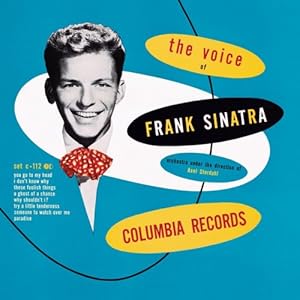
The Voice Of Frank Sinatra
Frank Sinatra
1946
The first concept album? Certainly the only album I own that was originally released as a literal album - a collection of four 78 rpm records (with one song on each side of a disc).
Two things struck me about this album. Firstly, I was surprised to find that Sinatra - who I think of as a fat old man singing slightly flat - was recording as early as 1946. Seeing him as a much younger man in the pictures on this album is jarring. Secondly, it includes a version of "Try A Little Tenderness", a song that, in my ignorance, I assumed was first sung by Otis Redding. So I'm learning interesting things already.
To say that the music sounds dated is to miss the point. It was recorded sixty-five years ago. Those thin, scratchy strings were recorded with state-of-the-art technology. What hasn't dated is Sinatra's voice. Lighter and higher than it became later, it's still marvellously controlled and already has that distinctive ability to come in just under the note.
The songs are all very down-tempo romantic ballads. "Someone To Watch Over Me" is a beautiful song, sung beautifully. The aforementioned "Try A Little Tenderness" sounds strange as a traditional ballad - probably as odd as Otis Redding's version sounded to those who knew this version. Taken all together - and particularly with the ten bonus tracks supplementing the eight that made up the original album - it's a bit too cloying for me. Taken individually, the performances are all very good.
Stored in the circular file under
fifties,
mojo collection,
music,
review,
sinatra
08/09/2011
The Fifties In Music
I was having lunch with my friend Brian a couple of months ago when he asked me for some recommendations of what to listen to. He'd - finally - given up on Q magazine and the relentless attempt to keep up with whatever hip 'n' happenin' new music being dictated by increasingly desperate major music companies, and wondered what classics he might have been missing from the past.
I had plenty to say, of course, and I recommended a number of albums. But the main thing I suggested was that he get hold of one or two of these "list" books. Whatever your views on such things, the one thing they do is serve as an excellent starting point for discovering music. Personally, I rather like these books, and I think the reason why was summarised very well in an amusing online review of The Mojo Collection:
I'm not the first to think so, either. The 1001 Albums book has inspired a number of blogs from people attempting to obey the title and listen to everything - in order. Some of these are still going (the second one has finished and moved onto The Mojo Collection) and some gave up. But the attempt is worthwhile if you end up listening to new music.
So - pausing only to order 1001 Albums from Amazon - I decided to start myself. I'm not *quite* so anal that I insist on listening to one album per day in strict order (neither am I self-disciplined enough to only listen to one album a day). Neither am I married to the idea of doing only one book. Nevertheless, one has to start somewhere and limit scope somehow. I decided to stick with the two books I had and start with the fifties - an under-represented decade in my collection.
Here is the combined list of albums from the fifties from the two books, in chronological order (and alphabetically by artist within the year).
I've got all of these now (oh yes, no mere listening for me, only owning will do). I already owned a few before starting this venture (the Miles Davis albums); doubtless I could have found all online somewhere (and in a couple of cases of severe unavailability, I had to resort to this) but I wanted to own them. And, to be honest, it's £170 well spent. Nothing cost more than a tenner and average cost was about £6. And much of the music is wonderful.
What have I learned? The music that has aged most is the rock 'n' roll, which now sounds primitive, dated and thin (although this wasn't helped by the fact that the version of This Is Fats that I got was mastered at the wrong speed! How is this possible?). The "standards" stand up very well. The Sinatra albums on this list are the bedrock of his reputation and, having only been familiar with the bloated old codger singing "My Way", I was very pleasantly surprised. And my favourite album is from a genre I would have bet actual real money on not liking - country (or, more probably, western, given the subject matter). It's the Marty Robbins album and it's very catchy and sounds excellent.
More investigation into related music can be found at this wonderfully statistical site that aggregates all the list books into a set of "best" albums per year, genre etc.
I had plenty to say, of course, and I recommended a number of albums. But the main thing I suggested was that he get hold of one or two of these "list" books. Whatever your views on such things, the one thing they do is serve as an excellent starting point for discovering music. Personally, I rather like these books, and I think the reason why was summarised very well in an amusing online review of The Mojo Collection:
Books like the Mojo Collection have a curious effect; one is simultaneously consoled and rebuked by the lists themselves. As surely as one pats oneself on the back with one's left hand for possessing the most excellent bodaciousness of mind to be the owner of an original, pre-'Sex & Drugs & Rock & Roll' copy of New Boots & Panties (and Out of the Blue) one's right hand wields the whip in readiness for the flagellation necessitated by one's failure to have got round to picking up that beautifully re-mastered version of Pacific Ocean Blue.The conversation remained with me and I dug out my own copy of The Mojo Collection (ed. Jim Irvin, 1998) and also happened to find 1001 Albums You Must Hear Before You Die (ed. Robert Dimery, 2005) in the library. Looking through them, I realised that my own knowledge was fairly spotty, particularly pre-1970. Maybe my own musical knowledge needed a little updating.
I'm not the first to think so, either. The 1001 Albums book has inspired a number of blogs from people attempting to obey the title and listen to everything - in order. Some of these are still going (the second one has finished and moved onto The Mojo Collection) and some gave up. But the attempt is worthwhile if you end up listening to new music.
So - pausing only to order 1001 Albums from Amazon - I decided to start myself. I'm not *quite* so anal that I insist on listening to one album per day in strict order (neither am I self-disciplined enough to only listen to one album a day). Neither am I married to the idea of doing only one book. Nevertheless, one has to start somewhere and limit scope somehow. I decided to stick with the two books I had and start with the fifties - an under-represented decade in my collection.
Here is the combined list of albums from the fifties from the two books, in chronological order (and alphabetically by artist within the year).
- Frank Sinatra: The Voice Of Frank Sinatra (1946) M
- Peggy Lee: Black Coffee (1953) M
- Julie London: Julie Is Her Name (1955) M
- Frank Sinatra: In the Wee Small Hours (1955) A
- Johnny Burnette & The Rock 'n' Roll Trio: Johnny Burnette & The Rock 'n Roll Trio (1956) M
- Fats Domino: This is Fats (1956) A
- Duke Ellington: Duke Ellington At Newport 1956 (1956) A
- Ella Fitzgerald: Ella Fitzgerald Sings The Cole Porter Songbook (1956) M
- The Louvin Brothers: Tragic Songs of Life (1956) A
- The Four Freshmen: Four Freshmen And Five Trombones (1956) M
- Elvis Presley: Elvis Presley (1956) A
- Louis Prima: The Wildest! (1956) A
- Frank Sinatra: Songs For Swinging Lovers (1956) M A
- Mose Allison: Back Country Suite (1957) M
- Count Basie Orchestra: The Atomic Mr Basie (1957) A
- Nat King Cole: Love Is The Thing (1957) M
- The Crickets: The "Chirping" Crickets (1957) M A
- Little Richard: Here’s Little Richard (1957) A
- Miles Davis: Birth Of The Cool (1957) M A
- Machito: Kenya (1957) A
- Thelonious Monk: Brilliant Corners (1957) A
- SabĂș: Palo Congo (1957) A
- Jack Elliott: Jack Takes the Floor (1958) A
- Billie Holiday: Lady In Satin (1958) M A
- Mahalia Jackson: Newport 1958 (1958) M
- Tito Puente & His Orchestra: Dance Mania Vol. 1 (1958) A
- Nina Simone: Jazz As Played In An Exclusive Side Street Club (1958) M
- Frank Sinatra: Come Fly With Me (1958) M
- Frank Sinatra: Sings For Only The Lonely (1958) M
- Sarah Vaughan: At Mister Kelly’s (1958) A
- Dave Brubeck: Time Out (1959) A
- Ray Charles: The Genius Of Ray Charles (1959) A
- Miles Davis: Kind Of Blue (1959) M A
- Ella Fitzgerald: Ella Fitzgerald Sings the Gershwin Song Book (1959) A
- Charles Mingus: Ah Um (1959) M
- Marty Robbins: Gunfighter Ballads And Trail Songs (1959) M A
(Key: M = Mojo Collection; A = 1001 Albums)
I've got all of these now (oh yes, no mere listening for me, only owning will do). I already owned a few before starting this venture (the Miles Davis albums); doubtless I could have found all online somewhere (and in a couple of cases of severe unavailability, I had to resort to this) but I wanted to own them. And, to be honest, it's £170 well spent. Nothing cost more than a tenner and average cost was about £6. And much of the music is wonderful.
What have I learned? The music that has aged most is the rock 'n' roll, which now sounds primitive, dated and thin (although this wasn't helped by the fact that the version of This Is Fats that I got was mastered at the wrong speed! How is this possible?). The "standards" stand up very well. The Sinatra albums on this list are the bedrock of his reputation and, having only been familiar with the bloated old codger singing "My Way", I was very pleasantly surprised. And my favourite album is from a genre I would have bet actual real money on not liking - country (or, more probably, western, given the subject matter). It's the Marty Robbins album and it's very catchy and sounds excellent.
More investigation into related music can be found at this wonderfully statistical site that aggregates all the list books into a set of "best" albums per year, genre etc.
Stored in the circular file under
1001 albums,
fifties,
mojo collection,
music
02/05/2011
"The Adventures Of Sherlock Holmes" (1892)
by Sir Arthur Conan Doyle
When I'm ill I don't really want to be challenged or stimulated. I'd rather have something familiar or at least predictable. So during my latest cold I pulled the Sherlock Holmes books off the shelf. In fact, this is all five books of short stories in one large volume, so it wasn't a great choice - reading such a heavy book in bed probably wasn't ideal for someone feeling weakened anyway!
Still, the stories are always enjoyable and met my needs perfectly well. Given how old they are the stories are remarkably undated.
19/01/2011
The Road To Gandolfo
Robert Ludlum
1975
Originally published under a pseudonym, The Road To Gandolfo is unusual for Ludlum in that it's a comedy novel. And, as such, I find it much more appealing that his serious thrillers, and it's the book of his that I've re-read the most times.
The plot concerns an epic con undertaken by an ex-Army General. It's not particularly intricate but there's lots of entertaining detail. And it's not too heavyweight, either - unlike such back-breakers like the Jason Bourne novels.
All in all, one of his lesser known books but worth finding.
15/01/2011
Don't You Know Who I Am?
Piers Morgan
(2007)
Pretty much everything I know about Piers Morgan repels me. Obviously, as an ex-editor of the News Of The World, he is already highly morally suspect (and, let's be honest, that would have been true even without the phone hacking revelations this year) and any reading of his activities, both as a newspaper editor and as a TV celebrity, does little to dispel this.
Given all this, I'm not sure why I bothered with the book. It was cheap - about a quid at Oxfam - and I was curious.
It's a diary of his life and covers the period in his life between getting sacked as editor of The Daily Mirror and being appointed as a judge on America's Got Talent. The same period also roughly - and presumably coincidentally - covers the time between separating from his first wife and starting a relationship with the woman who became his second.
The theme of the book is celebrity. Morgan, casting around for a way of earning a living, decides that he would like to become a celebrity and work in television. The book discusses the ways he attempts this. This includes a flop current affairs programme, Morgan and Platell (which was modelled on those tiresome US-style programmes that pits opposing views). I was surprised to read that Morgan was supposed to be the left-wing viewpoint in this setup.
Despite all of this, the book is an entertaining read. Piers Morgan is clearly not a stupid man and neither is he devoid of self-knowledge. What he chooses to do with that intelligence and self-awareness is a bit depressing but amusing to read about.
Stored in the circular file under
book,
piers morgan,
review
14/01/2011
"How I Escaped My Certain Fate"
The Life And Deaths Of A Stand-Up Comedian by Stewart Lee
It seems like all comedians produce books now - I guess it's just another aspect of the revenue stream for them. I haven't read any because I'm not that interested in them as people and I don't really find many of them truly funny - at least, not the famous ones.
Stuart Lee doesn't find many of them funny either, although he is happy to admit that he used to find them funny before they became famous. One of the threads running through the book is about the unrecognised trailblazers who have fearlessly broken comedic ground in dives around the country. He thinks Johnny Vegas is a genius, for example; not for his television appearances but his live performances.
Anyway, what we have here is not a life history of Stuart Lee, although it does cover some of his recent past. At its core it is three of his recent shows/routines, transcribed and heavily annotated, and interspersed with lengthy and entertaining essays about what he was trying to do, the points he was trying to make and what effect he was trying to achieve.
The book starts with him attempting to reinvent his stage persona after he realised that he had become predictable (and also after he discovered that Ricky Gervais had essentially appropriated it for his own stage persona). He discusses the way comedy works - or how his comedy works - and goes back to some of his inspirations and heroes. It then covers the next several years of routines, visits to the Edinburgh fringe and his attempts to get something on telly (not his favourite medium, clearly, but one that pays a lot more than touring).
I haven't seen Stuart Lee live but a quick search on YouTube gives us plenty to look at (e.g. excerpts from his show "41st Best Standup", one of the routines in the book), and it hardly needs mentioning that the routines are a lot funnier to watch than written down on paper, but they're still pretty good to read.
He also discusses in detailed footnotes why he does something. Here he does a bit about Richard Littlejohn chiseling words on a gravestone; he does the sound effect of the chiseling by knocking the microphone on the stand. In the book he mentions that he would entertain himself by seeing how long he could draw out the sound effect without losing the crowd.
The book is a very interesting read from the perspective of the craft of comedy, and not just a funny book - even if it is a way of making more money from existing material. Although there's so much more in this book than the routines, so that's probably a little unfair. Recommended, and I'll take the time to look for more of his stuff.
Stored in the circular file under
book,
review,
stuart lee
Subscribe to:
Posts (Atom)